

Assessment Consulting and the Art of Not Getting Hacked
Why Every Houston Business Needs a Cyber Security Risk Consultant Right Now
A cyber security risk consultant is a specialized advisor who helps organizations identify, evaluate, and reduce their exposure to digital threats — before those threats become costly incidents.
Here’s what a cyber security risk consultant does at a glance:
| Function | What It Means for Your Business |
|---|---|
| Risk assessment | Finds vulnerabilities in your systems before attackers do |
| Threat modeling | Maps out the most likely attack scenarios for your industry |
| Compliance guidance | Keeps you aligned with regulations and industry standards |
| Incident readiness | Prepares your team to respond fast when something goes wrong |
| Strategic advisory | Aligns security decisions with your business goals |
The numbers are hard to ignore. Cybercrime is projected to cost the world $10.5 trillion per year in 2025. Meanwhile, 74% of CEOs say they’re worried about their ability to minimize cyberattacks — and that’s before factoring in the growing geopolitical instability that security leaders warn could trigger a catastrophic cyber event in the near future.
For business owners in manufacturing, construction, banking, and professional services, the risk isn’t abstract. Downtime, data loss, and compliance failures have real dollar amounts attached to them.
I’m Roland Parker, founder and CEO of Impress Computers, and I’ve spent over 30 years helping Houston-area businesses build secure, resilient IT infrastructure — work that puts cyber security risk consulting at the center of everything we do. In this guide, I’ll walk you through exactly how to identify your risks, what to look for in a consultant, and how to build defenses that actually hold.
Defining the Role of a Cyber Security Risk Consultant
In the simplest terms, a cyber security risk consultant is a professional who identifies problems, evaluates security issues, assesses risk, and implements solutions to defend against threats to networks and systems. While an IT technician might fix a broken printer or reset a password, a consultant looks at the “big picture.” They ask: “If a hacker wanted to shut down this manufacturing plant in Katy, how would they do it, and how do we stop them?”

At Impress Computers, we view this role as a strategic business enabler. It isn’t just about saying “no” to new software; it’s about finding a way to use that software safely so your business can grow. Whether you are looking for Houston IT services or a deep-dive security audit, the goal is the same: to move from a reactive state (fixing things after they break) to a proactive state (preventing the break in the first place).
When deciding how to bring this expertise into your organization, you generally have two paths: hiring an in-house expert or partnering with an external firm.
| Feature | In-House Consultant | External Consulting Firm (Managed Services) |
|---|---|---|
| Cost | High (Salary + Benefits + Training) | Scalable (Monthly service fee) |
| Availability | 40 hours a week | 24/7 Monitoring & Support |
| Breadth of Knowledge | Deep knowledge of one system | Broad knowledge across many industries |
| Response Time | Immediate (if on-site) | Guaranteed (e.g., our 15-minute guarantee) |
| Tools | Limited by internal budget | Access to enterprise-grade tools |
Key Responsibilities of a Cyber Security Risk Consultant
The daily life of a cyber security risk consultant is a mix of detective work and engineering. They don’t just sit around waiting for an alarm to go off. Their daily tasks often include:
- Threat Research: Staying up to date on the latest malware strains. For example, we recently alerted our clients to new Klogexe and Fpspy malware threats that have been targeting businesses.
- Vulnerability Testing: Running scans to see if your software is outdated or if your firewall has a “hole” in it.
- Technical Reporting: Translating complex jargon into a report that a business owner in Sugar Land or Richmond can actually understand and act upon.
- Incident Readiness: Creating a “playbook” so everyone knows exactly what to do if a ransomware note pops up on a screen.
- Security Posture Evaluation: Looking at your entire digital footprint—from your office in Houston to your remote workers in The Woodlands—to see where the weak links are.
Essential Skills for a Cyber Security Risk Consultant
To be successful, a consultant needs a very specific “utility belt” of skills. It isn’t just about being good with computers; it’s about understanding how humans and businesses work.
- Technical Hard Skills: This includes ethical hacking (thinking like a bad guy to find weaknesses), cloud security (protecting data in Azure or AWS), and encryption.
- Soft Skills: Communication is arguably the most important skill. A consultant must be able to explain to a CEO why a $10,000 investment in security is better than a $1,000,000 ransom payment.
- Workplace Skills: Leadership and collaboration are key, as they often have to work alongside your existing IT team or department heads.
If you are looking to dive deeper into the career path and required knowledge for this role, the ISACA’s guide to cybersecurity consulting provides an excellent roadmap of the professional landscape.
Navigating the Modern Threat Landscape
The world has changed. We’ve seen a 200% increase in disruption levels between 2017 and 2022. It’s no longer just about a “lone wolf” hacker in a basement; it’s about organized crime syndicates and geopolitical actors.
According to the WEF Global Cybersecurity Outlook 2026, the widening “cyber inequity” between prepared and unprepared businesses is a major risk. While big banks might have massive budgets, small-to-medium businesses (SMBs) in Houston are often the easiest targets because they lack a dedicated cyber security risk consultant.
We are also seeing a massive surge in specific attack types. For instance, Cloudflare blocked 21.3 million DDoS attacks in 2024—a 53% increase over the previous year. That averages out to nearly 5,000 attacks every single hour. Furthermore, we must stay vigilant against Microsoft warnings on business email compromise, which remains one of the most financially damaging ways for a hacker to infiltrate a business.
Emerging Risks: AI and Quantum Security
Two “buzzwords” are currently keeping security consultants awake at night: AI and Quantum.
- Generative AI: While we use AI to detect threats, hackers use it to write perfect phishing emails or create “deepfake” audio to trick employees into transferring money.
- Quantum Computing: Experts estimate that 75% of encryption in use today is at risk from future quantum computing breakthroughs. This is why “quantum-safe” solutions are becoming a major part of long-term risk consulting.
Even standard protocols aren’t safe. For example, there are new findings on HTTP/2 protocol vulnerabilities that could allow attackers to overwhelm servers with minimal effort. A consultant’s job is to see these trends coming and patch your systems before the “bad guys” catch up.
How to Conduct a Comprehensive Cyber Risk Assessment
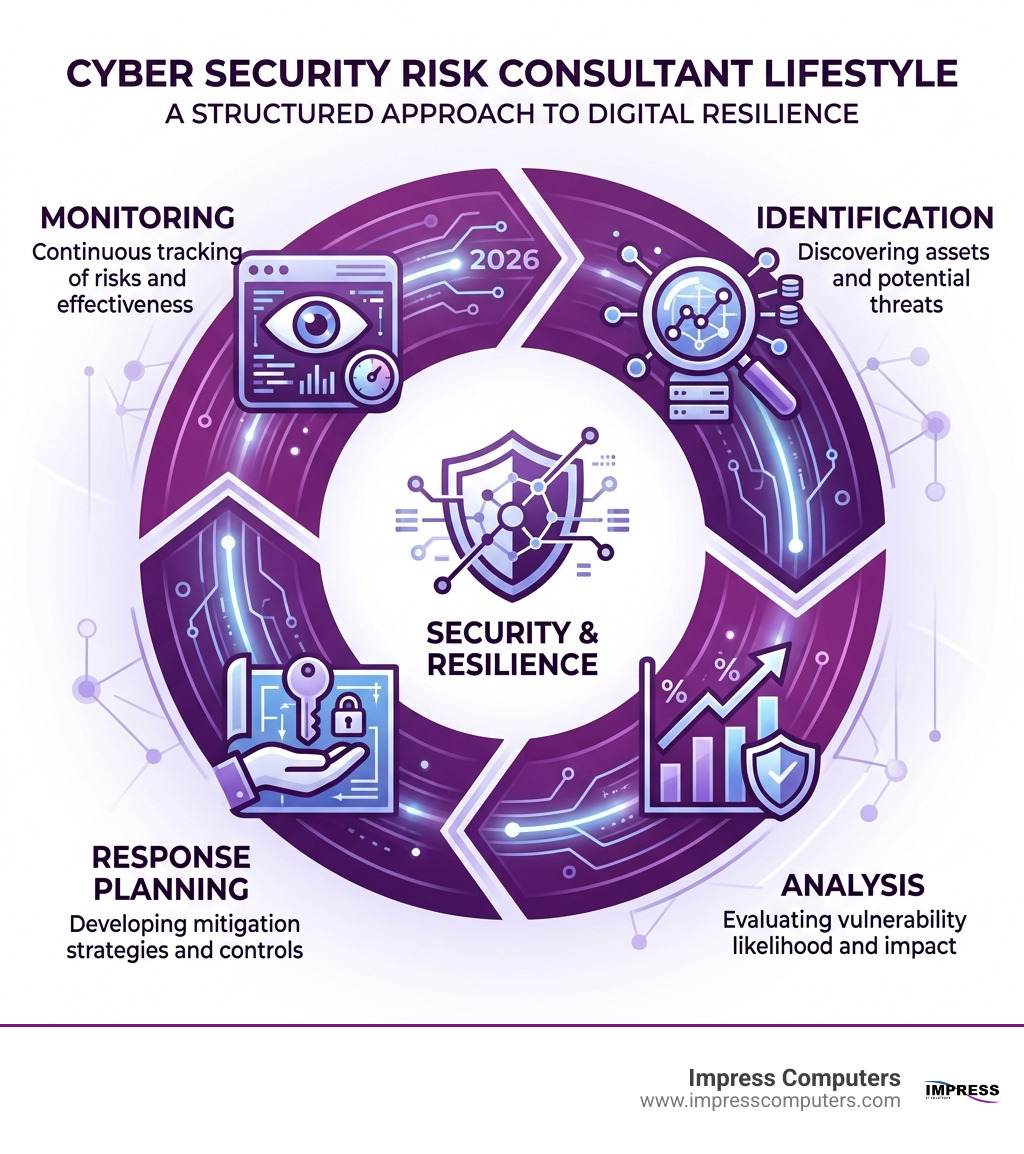
If you’re wondering how we actually “do” the consulting, it follows a very structured process. You can’t protect what you don’t know you have.
- Asset Identification: We list every computer, server, smartphone, and “smart” device (like a connected thermostat in a warehouse) that connects to your network.
- Threat Modeling: We look at your specific industry. A construction firm in Fulshear has different risks (like stolen blueprints or project delays) than a CPA firm in Missouri City (like stolen Social Security numbers).
- Impact Analysis: We ask, “If this server goes down, how much money does the company lose per hour?”
- Remediation Planning: This is the “How-To” part. We create a prioritized list of what to fix first. Usually, preventing data loss for businesses starts with the basics: backups, multi-factor authentication, and employee training.
For many of our local partners, protecting small businesses in the digital age isn’t about buying the most expensive software; it’s about having a solid plan and a consultant who knows where the “tripwires” are.
Tools and Methodologies for Risk Mitigation
We don’t just guess where the risks are. We use industry-standard frameworks and tools:
- Risk IT Framework: A methodology that connects business goals with IT assets.
- Penetration Testing: Also known as “Pen Testing.” This is where we safely try to hack into your system to see if your defenses hold.
- Vulnerability Analysis: Automated tools that check for known bugs in your software.
- ITAF Standards: These ensure that our audits are consistent and effective.
- Phishing Simulations: Since 90% of attacks start with an email, we provide expert tips on spotting phishing links and test your employees to see who clicks.
Building Resilience and Regulatory Compliance
Being “secure” isn’t enough. You have to be resilient. Resilience means that when you do get hit (and eventually, everyone faces a threat), you can bounce back without losing your business.
A major part of this is Zero Trust. The old way of thinking was: “Once you’re inside the office network, we trust you.” The Zero Trust way is: “We trust no one. Verify every device, every time.” This is especially important for our clients in the banking and legal sectors who deal with highly sensitive data.
Our compliance services help Houston businesses navigate the alphabet soup of regulations—HIPAA, GDPR, CMMC, and more. If you are in manufacturing, you also have to worry about “cyber-physical” security—ensuring a hacker can’t take control of a CNC machine or a power grid.
The demand for these services is skyrocketing. The BLS cybersecurity employment projections show a 33% increase in jobs through 2033. This is because the importance of cybersecurity for small businesses has shifted from a “luxury” to a “survival requirement.”
Frequently Asked Questions about Cyber Risk Consulting
What is the average salary for a cyber security risk consultant?
As of March 2025, the compensation for these roles is quite high, reflecting the level of responsibility. According to Glassdoor salary data for consultants, the average total annual salary in the US is $283,304. This typically includes a base salary of around $177,508 plus additional pay (bonuses or profit sharing) of over $100,000. Entry-level consultants can expect to start around $101,000, with pay scaling significantly as they gain 10-15 years of experience.
Which certifications are most valuable for risk consultants?
If you are looking to hire a cyber security risk consultant, you should look for these “gold standard” certifications:
- CISM (Certified Information Security Manager): Focused on management and strategy. You can find ISACA CISM certification details here.
- CRISC (Certified in Risk and Information Systems Control): The “bread and butter” for risk consultants.
- CISSP (Certified Information Systems Security Professional): A broad, high-level security certification.
- CEH (Certified Ethical Hacker): Proves they know how attackers think.
How often should a business perform a risk assessment?
At a minimum, you should conduct a comprehensive review annually. However, you should also trigger a new assessment if:
- You move to a new office (e.g., moving from Houston to a larger facility in Brookshire).
- You adopt major new software or move to the cloud.
- A major industry breach occurs that highlights new vulnerabilities.
- You want to stay ahead of the curve by attending a protecting your business from attack webinar to see what new threats have emerged.
Conclusion
The “Art of Not Getting Hacked” isn’t about being perfect; it’s about being prepared. A cyber security risk consultant acts as your digital sentry, watching the horizon so you can focus on running your business.
At Impress Computers, we’ve spent decades serving the Houston, Katy, and Sugar Land communities. We understand the specific needs of manufacturing plants in Rosenberg and law firms in the Galleria. We don’t just offer advice; we offer a 15-minute response guarantee and 99.9% uptime, ensuring that your business stays resilient no matter what the threat landscape looks like.
Don’t wait for a ransomware note to realize you have a gap in your defenses. Secure your business with Houston IT support today and let us help you de-risk your tomorrow.
