
Why Email Security for Banks Is a Critical Business Priority
Email security for banks is one of the most urgent cybersecurity challenges facing financial institutions today. Here is a quick summary of what matters most:
Top email security priorities for banks and financial institutions:
| Priority | Why It Matters |
|---|---|
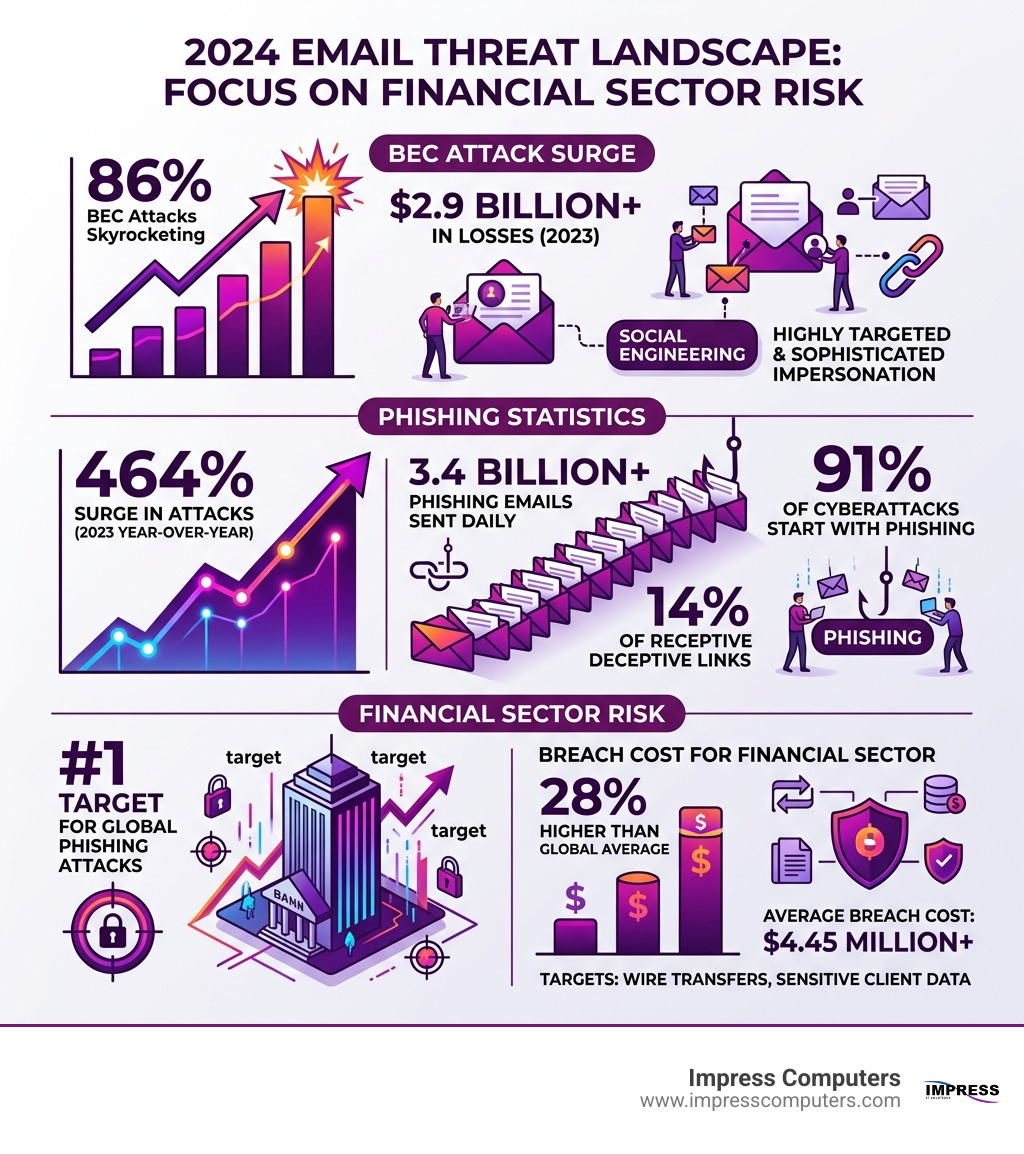
| Anti-phishing protection | 91% of all cyberattacks start with a phishing email |
| Business Email Compromise (BEC) defense | BEC losses hit nearly $3 billion in 2023 alone |
| Data Loss Prevention (DLP) | Financial sector breaches cost 28% more than the global average |
| Email authentication (DMARC/SPF/DKIM) | Prevents domain spoofing and impersonation attacks |
| AI-powered threat detection | Catches zero-day and socially engineered threats legacy tools miss |
| Employee training | 95% of data breaches involve human error |
The numbers are hard to ignore. Global email cyberattacks surged 464% year-over-year in 2023. More than 3.4 billion phishing emails are sent every single day. And financial institutions are the single most targeted sector — ranked the #1 target for global phishing attacks by Q4 2022.
For banks and CPAs, the stakes go beyond lost money. A single breach can cost an average of $4.45 million — and that figure climbs even higher for financial services firms. Sensitive client data, wire transfer credentials, and regulatory obligations make every inbox a potential entry point for attackers.
The hard truth? Most organizations are still relying on outdated tools to fight a very modern threat.
I’m Roland Parker, founder and CEO of Impress Computers, a managed IT and cybersecurity firm serving Houston-area businesses since 1993 — including banks, credit unions, and CPA firms that depend on airtight email security for banks to stay compliant and operational. In this guide, I’ll walk you through exactly what works, what doesn’t, and how to build a defense that keeps pace with today’s threats.
Email Security for Banks: Moving Beyond Legacy Gateways
For years, the standard for email security for banks was the Secure Email Gateway (SEG). Think of it like a bouncer at the door of your mail server. Systems like Cisco IronPort were the gold standard, but the world has changed. These legacy systems rely heavily on “signatures”—essentially a database of known “bad” files or links.
The problem? Modern attackers don’t use old tricks. They use zero-day exploits and social engineering that have no signature yet. We’ve seen many Houston financial institutions struggle with legacy SEGs because they require constant manual tuning and still let sophisticated phishing through.
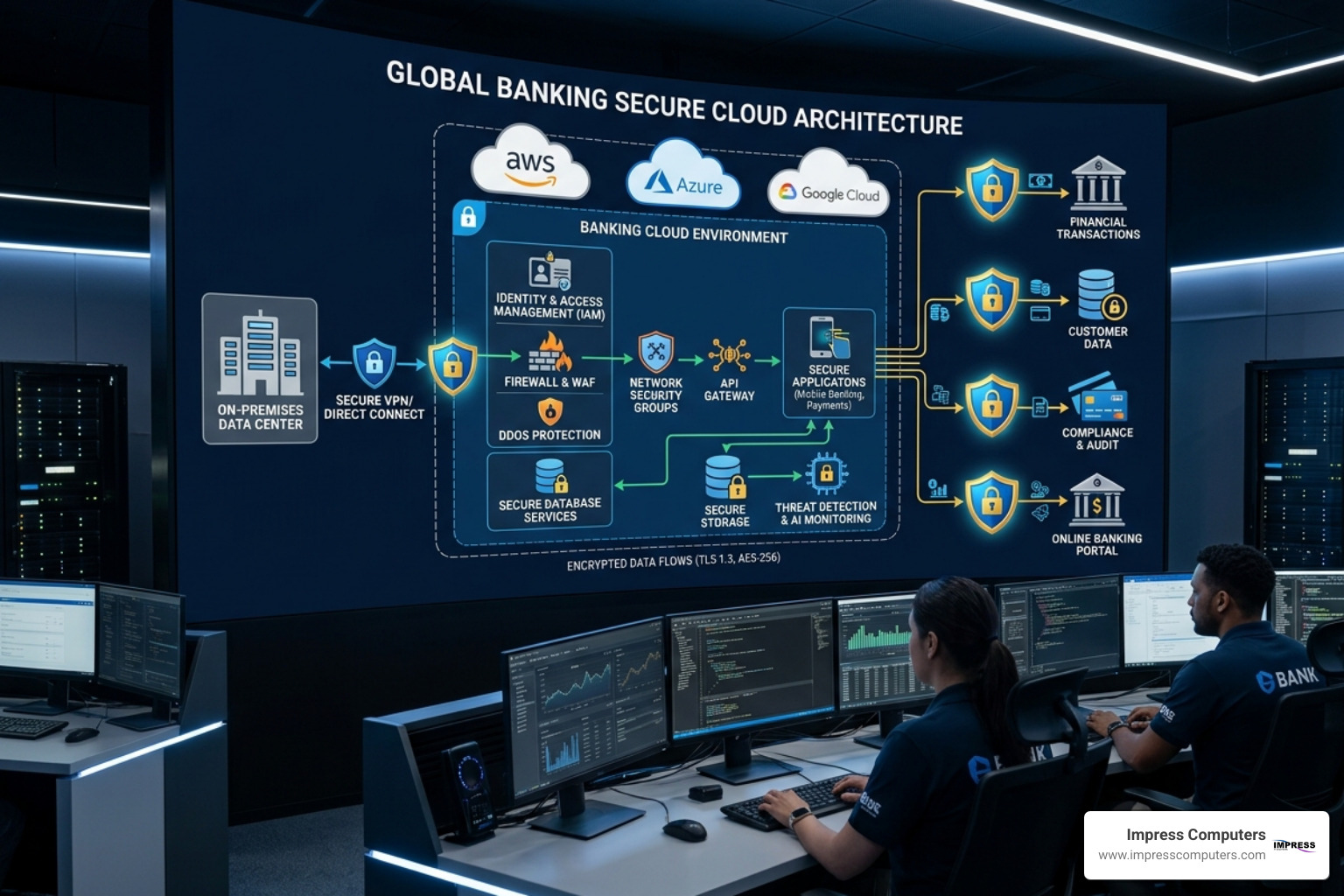
Today, we advocate for modern API-based platforms. These integrate directly into your Microsoft 365 environment. Instead of sitting in front of your mail flow (which can cause delays and configuration headaches), they sit inside it. This allows for rapid deployment—often in under 48 hours—and provides a level of visibility legacy gateways simply can’t match.
| Feature | Legacy SEGs (e.g., IronPort) | Modern API-Based Platforms |
|---|---|---|
| Detection Method | Signature-based / Static Rules | AI / Behavioral Analysis |
| Deployment Time | Weeks (requires MX record changes) | Hours (API integration) |
| Maintenance | High (constant manual tuning) | Low (automated learning) |
| Internal Email | Often ignored | Fully scanned for lateral threats |
| Social Engineering | Easily bypassed | Highly effective detection |
According to scientific research on FFIEC bank information security, banks must ensure their email controls are commensurate with their risk profile. For a modern bank, that means moving toward proactive threat prevention like real-time sandboxing and multiscanning. If you want to dive deeper into how this fits into your overall IT strategy, check out our more info about banking and financial IT services.
Advanced Threat Detection in Email Security for Banks
In the current landscape, “good enough” is a dangerous mindset. Advanced email security for banks now requires AI-driven analysis. These systems don’t just look at a link; they look at the behavior of the sender. Does this person normally email your CFO at 2:00 AM? Is the language used consistent with their previous 100 emails?
We use tools that employ machine learning and behavioral heuristics to spot anomalies. One of the most powerful tools in our arsenal is Deep CDR (Content Disarm and Reconstruction). Instead of just scanning an attachment, Deep CDR strips away all potentially malicious code, rebuilds the file from scratch, and delivers a clean, safe version to the user. This is critical for stopping zero-day malware that hasn’t been identified by antivirus software yet.
Furthermore, we’ve seen a massive rise in “quishing” or QR code phishing. Attackers hide malicious links in QR codes to bypass traditional text scanners. Modern security layers now perform time-of-click analysis, meaning every link is checked the moment a user clicks it, not just when the email arrives. This protects your staff if a safe-looking link is “weaponized” hours after delivery.
Data Loss Prevention as a Pillar of Email Security for Banks
While most people think of security as keeping the “bad guys” out, for banks and CPAs, keeping the “good data” in is just as important. Data Loss Prevention (DLP) is the safety net that prevents sensitive information from leaving your building—either by accident or by malice.
Whether it’s a teller accidentally emailing a spreadsheet with Social Security numbers or a disgruntled employee trying to exfiltrate client lists, DLP acts as an automated monitor. It can redact PII (Personally Identifiable Information) in real-time or block the email entirely. This is a non-negotiable part of regulatory compliance for GDPR, GLBA, and Texas-specific privacy laws.
How Secure is Your Email? Are Hackers in Your Account Right Now? This is a question we ask every new client. Without adaptive DLP and strong encryption-at-rest using TLS protocols, your institution is at risk of a compliance nightmare.
Essential Authentication and Compliance Frameworks
If you want to stop attackers from pretending to be you, you need to master the “alphabet soup” of email authentication: DMARC, SPF, and DKIM.
- SPF (Sender Policy Framework): A list of IP addresses authorized to send mail on your behalf.
- DKIM (DomainKeys Identified Mail): A digital signature that proves the email hasn’t been tampered with in transit.
- DMARC (Domain-based Message Authentication, Reporting, and Conformance): The “instruction manual” that tells receiving servers what to do if SPF or DKIM fails (e.g., “throw this in the trash”).
Scientific research on email authentication and .BANK domains highlights that moving to a .BANK domain provides an extra layer of verified identity. Unlike a .com domain, which anyone can buy, a .BANK domain requires rigorous verification. This acts as a “fortress of trust” for your customers.
Implementing these protocols isn’t just a “nice to have”—it’s often a requirement under frameworks like DORA (Digital Operational Resilience Act), NIS2, and PCI-DSS. For more tactical advice on this, see our guide on Business Email Compromise: Ways to Prevent Email Hacks.
Strengthening the Human Firewall
Even the most expensive email security for banks can be defeated by a single click from a well-meaning employee. With 95% of data breaches involving human error, your staff is either your greatest weakness or your strongest defense.
We recommend a “Trust but Verify” culture. This involves:
- Phishing Simulations: Sending “fake” phishing emails to staff to see who clicks. It’s not about “gotcha” moments; it’s about education.
- MFA and Biometrics: Multi-Factor Authentication can prevent up to 90% of cyberattacks. Even if a hacker gets a password, they can’t get into the account without that second code or a fingerprint.
- Redundant Approvals: Never allow a wire transfer or a change in payment instructions based on an email alone. Always verify via a secondary, known-good channel (like a phone call).
For a quick checklist you can share with your team, read Stop Business Email Compromise (BEC) Lures: The 4 Rules Every Employee Must Follow. Teaching your team to recognize executive impersonation and “urgent” requests from the CEO is the most cost-effective security upgrade you can make.
Frequently Asked Questions about Financial Email Security
Why is email the primary attack vector for banks?
Email is the path of least resistance. It allows attackers to bypass physical security and firewalls by targeting the person sitting behind the computer. Since banks deal in high-value transactions and sensitive data, the “ROI” for a successful phishing attack is massive.
What are the key differences between SEGs and API-based security?
Secure Email Gateways (SEGs) act as a proxy, which can lead to “blind spots” for internal-to-internal emails. API-based security integrates directly into the mailbox environment (like Microsoft 365), allowing it to scan every email, even those sent between employees, and deploy much faster without changing MX records.
How does AI improve phishing detection in banking?
AI doesn’t just look for bad links; it analyzes “contextual signals.” It can detect if an email’s tone is unusual, if a sender’s location is suspicious, or if a login attempt is anomalous. This allows it to catch “zero-day” phishing attacks that have never been seen before.
Conclusion
At Impress Computers, we understand that for banks and CPAs in the Houston area—from Katy to Sugar Land and Richmond—security isn’t just about software; it’s about business continuity and trust. We pride ourselves on our 15-minute response guarantee and our 99.9% uptime, ensuring that your institution stays protected without sacrificing productivity.
In an era where a single email can lead to a multi-million dollar loss, you need a partner with industry-specific expertise. Whether you are navigating the complexities of DORA compliance or simply trying to stop the daily barrage of phishing, we are here to help.
Protect your institution with advanced Email Security and let us turn your email from a liability into a secure asset. Give us a call today to see how we can harden your defenses and give you the peace of mind you deserve.
