

Why Every Houston Business Needs a Network and Security Consultant
A network and security consultant is a specialized expert who identifies vulnerabilities in your infrastructure, designs defenses, and helps your business stay protected — and compliant — before a breach happens.
Here is what a network and security consultant typically does:
- Assesses your network for weaknesses, misconfigurations, and open attack vectors
- Designs secure architecture tailored to your industry and compliance requirements
- Monitors threats and responds to incidents before they escalate
- Configures firewalls, access controls, and VPNs to reduce your attack surface
- Guides compliance with standards like ISO 27001, PCI DSS, and SOC 2
- Develops security policies and trains staff to reduce human error
Your business network is not just a technical asset — it is the foundation of every transaction, every client record, and every operational process you run. When it is compromised, everything stops.
The threat landscape has never been more active. Cyberattacks targeting small and mid-sized businesses in sectors like manufacturing, construction, and finance are rising sharply. The U.S. Bureau of Labor Statistics projects a 33% growth rate in demand for information security professionals through 2030 — a clear signal that organizations everywhere are actively working to close gaps they have ignored for too long.
Yet many Houston businesses are still relying on general IT support to handle what is fundamentally a specialized risk management problem. That mismatch is exactly where data leaks, compliance failures, and costly downtime begin.
I’m Roland Parker, Founder and CEO of Impress Computers, and I have spent over 30 years helping businesses across Houston secure their networks and navigate the growing complexity of IT risk — work that sits at the heart of what a network and security consultant delivers every day. In this guide, I will walk you through everything you need to know to protect your infrastructure, evaluate your options, and build a security posture your business can rely on.
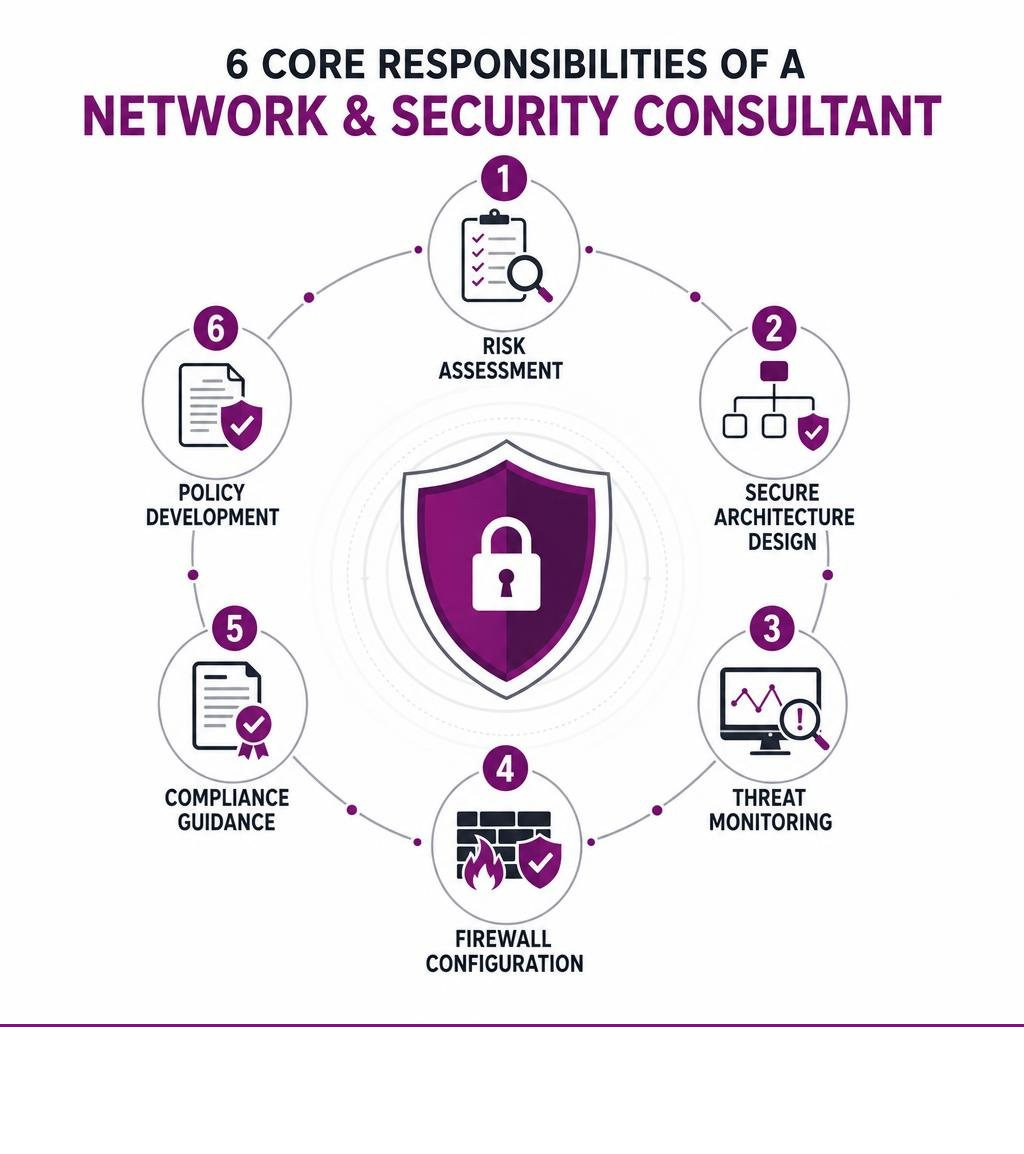
Simple guide to network and security consultant:
What Does a Network and Security Consultant Do?
While general IT service providers focus on day-to-day operations, system availability, and user helpdesk tickets, a network and security consultant operates at a strategic and specialized level. Their primary focus is identifying, mitigating, and managing risks to your digital assets. They look at your entire technical ecosystem to ensure that data flows efficiently where it should, while remaining completely locked down against unauthorized access.
General IT support keeps your printers connected and your software updated. In contrast, security consulting analyzes your network architecture for structural vulnerabilities, configures advanced security controls, and builds operational resiliency. For businesses in highly regulated sectors like banking, legal, CPA, and healthcare, this distinction is critical. General IT support is rarely equipped to handle the rigorous demands of regulatory audits, complex threat modeling, or deep forensic incident response.
By engaging a specialized consultant, you gain access to high-level expertise that aligns raw technology with business risk. Consultants design the blueprints that keep your operations running smoothly, ensuring that security is integrated into your infrastructure from its inception rather than treated as an afterthought.
For more information on how we manage these complex environments, explore our dedicated Cyber Security and Network Security service portals.
Core Services and Deliverables of a Network and Security Consultant
A professional consulting engagement is highly structured, delivering tangible improvements to your security posture. The core offerings typically include:
- Vulnerability Assessments and Security Audits: Comprehensive evaluations of your internal and external networks to find software bugs, unpatched systems, and configuration errors.
- Secure Architecture Design: Rebuilding or refining your network layout to enforce strict boundaries. This includes micro-segmentation, securing remote access pathways, and implementing secure cloud integrations.
- Firewall Configuration and Hardening: Moving beyond basic setups to establish granular firewall rules, intrusion prevention systems (IPS), and deep packet inspection. You can learn more about how we implement these defenses by reading The Role of Firewalls in Securing Networks and discovering the answers to the question, Do I Need a Firewall for My Small Business? Impress Computers Houston, TX.
- Network Monitoring and Threat Detection: Setting up continuous visibility tools to identify anomalous behavior before it turns into a full-scale breach. For practical details, read our guide on Effective Network Monitoring Techniques for Your Business.
- Incident Response Planning: Creating detailed, step-by-step playbooks so your team knows exactly how to contain, mitigate, and recover from a security incident without panic or prolonged downtime.
Specialized Consulting Roles in Modern IT
The cybersecurity field has evolved into highly specialized disciplines. When evaluating your organization’s needs, you may encounter several distinct consulting profiles:
- Virtual CISO (vCISO): A virtual Chief Information Security Officer provides executive-level leadership, risk management, and strategic security planning on a fractional basis. This role is highly valuable for mid-sized firms that need board-level guidance without the expense of a full-time executive.
- Penetration Testers: Also known as ethical hackers, these specialists actively attempt to breach your defenses using real-world attack vectors to prove where your vulnerabilities lie.
- Cloud Security and DevSecOps Consultants: Experts focused on securing cloud-native environments (such as AWS and Azure) and embedding automated security checks directly into software development pipelines.
To understand how these specialized roles align with standardized cybersecurity careers, you can reference the NIST National Initiative for Cybersecurity Education (NICE) Cybersecurity Workforce Framework, which defines the standards for modern security roles and responsibilities.
In-House IT vs. External Network and Security Consultants
One of the most common dilemmas faced by growing businesses in Houston, Katy, and Sugar Land is deciding whether to build an internal security team or hire external consulting expertise.
Building an in-house security operations center (SOC) requires a massive financial commitment. Between recruitment, high salaries, continuous training, and advanced software licensing, the costs can quickly overwhelm mid-sized budgets. Furthermore, internal IT staff often become overwhelmed by daily operational issues, leaving them little time to focus on strategic risk management or proactive threat hunting.
External consultants solve this problem by providing immediate access to senior-level expertise on demand. They bring a broad perspective gained from working across dozens of different environments, allowing them to spot emerging threat patterns that an isolated internal team might miss.
| Feature / Criteria | In-House IT Teams | External Consultants |
|---|---|---|
| Primary Focus | Day-to-day operations, user support, and system uptime | Strategic risk mitigation, security architecture, and compliance |
| Cost Structure | High fixed overhead (salaries, benefits, continuous training) | Predictable, scalable investment (project-based or retainer) |
| Depth of Expertise | Broad generalists; rarely specialized in advanced threat modeling | Deeply specialized in modern attack vectors, forensics, and compliance |
| Tooling & Licensing | Company must purchase and maintain complex security software | Consultant brings proprietary tools, methodologies, and partner networks |
| Objectivity | Can suffer from internal bias or overlook systemic legacy issues | Unbiased, independent third-party assessment of actual security posture |
For businesses looking to optimize this balance, our team provides tailored co-managed solutions. You can explore how we partner with local businesses by visiting our page on how to Get expert IT support in Houston.
Engagement Models and Pricing Structures
Every business has unique operational demands, which is why professional consulting services are structured under flexible engagement models:
- Project-Based Engagements: Ideal for defined objectives, such as preparing for an upcoming compliance audit, designing a new cloud infrastructure, or conducting a comprehensive vulnerability assessment.
- Retainer-Based Advisory: Provides your business with a set number of expert consulting hours each month. This is perfect for ongoing strategic guidance, vCISO services, and continuous risk management.
- Managed Security Services (MSSP): A comprehensive model where the consultant takes over ongoing security operations, including 24/7 monitoring, threat detection, and patch management.
By aligning the engagement model with your specific business goals, you ensure that your security budget is directly tied to measurable risk reduction.
Evaluating Consultant Expertise and Methodologies

Selecting the right partner is a critical business decision. A credible consultant must demonstrate a clear methodology that prioritizes technical integrity over sales rhetoric. They should focus on practical alignment—ensuring that every security control they recommend directly supports your business operations rather than creating unnecessary friction.
When evaluating potential partners, look for those who demonstrate a deep understanding of your specific industry. A manufacturing plant in Katy has vastly different operational technology (OT) risks than a CPA firm in Galleria or a legal practice in Woodlands. Your consultant should speak the language of your business, not just the language of technology.
Qualifications of a Credible Network and Security Consultant
To ensure you are working with a true expert, verify that their team holds industry-recognized, gold-standard certifications. These credentials require rigorous testing, verified field experience, and ongoing continuing education:
- CISSP: The ISC2 Certified Information Systems Security Professional (CISSP) is widely considered the gold standard for security leadership, architecture, and program management.
- CISM: The ISACA Certified Information Security Manager (CISM) validates senior-level expertise in managing, designing, and overseeing enterprise information security programs.
- CEH: The EC-Council Certified Ethical Hacker (CEH) ensures the consultant understands the offensive tactics, techniques, and procedures used by modern threat actors.
In addition to certifications, look for proven real-world experience. Ask for case studies or references that demonstrate how they have successfully resolved complex security challenges for businesses similar to yours.
Building a Security Program from Scratch
A mature security program is not built simply by installing software; it requires a structured approach to governance, policies, and culture. A professional consultant will guide you through this process step-by-step:
- Define Risk Tolerance: Documenting what level of risk your business is legally and operationally willing to accept.
- Establish Security Policies: Drafting clear, enforceable rules governing data access, device usage, and remote work.
- Implement Technical Controls: Deploying firewalls, multi-factor authentication (MFA), and encryption.
- Foster a Security Culture: Educating your workforce to recognize phishing attempts, social engineering, and physical security risks. Learn more about this by reading The Importance of Having a Security Culture in Business.
- Enforce Password Hygiene: Establishing modern credential policies. Review our best practices in Strengthening Your Business’s Security: Best Practices for Password Protection.
Navigating Compliance, Industry Challenges, and Future Trends
Regulatory pressure has never been higher. Modern organizations must navigate a complex array of compliance frameworks to protect customer data and maintain their business licenses. A professional consultant acts as your guide through these complex requirements, helping you achieve and maintain compliance with key standards:
- ISO/IEC 27001: The international standard for managing information security. Learn more about the framework directly from the ISO/IEC 27001 Information Security Management portal.
- PCI DSS: Essential for any business that processes, stores, or transmits credit card data. You can access the official guidelines via the PCI Security Standards Council (PCI DSS) website.
- SOC 2 Type II: A rigorous audit report that evaluates your operational controls over security, availability, processing integrity, confidentiality, and privacy over a sustained period.
Furthermore, businesses operating globally or within critical supply chains must now prepare for emerging international regulations. This includes the European Union’s NIS2 directive and the European Commission Digital Operational Resilience Act (DORA), which impose strict cybersecurity and operational resilience mandates on financial institutions and critical infrastructure providers.
Modern Security Paradigms
As traditional network perimeters dissolve due to remote work and cloud adoption, consultants are helping organizations transition to modern, resilient security architectures:
- Zero Trust Architecture: Moving away from the outdated assumption that everything inside a corporate network can be trusted. Under Zero Trust, every user and device must be continuously verified, authenticated, and authorized before being granted access. This framework is detailed in the authoritative NIST SP 800-207 Zero Trust Architecture standard. You can also explore our local implementation strategies by reading how to Protect Your Data and Network by Using Zero Trust.
- Cloud-Native Security: Implementing security controls specifically designed for dynamic cloud environments, ensuring that misconfigurations are automatically detected and remediated.
- AI-Driven Threat Mitigation: Leveraging machine learning algorithms to analyze network traffic patterns in real-time, allowing us to block sophisticated cyber threats before they can execute.
To understand why these security elements are so critical to your overall business health, read our detailed analysis on The Importance of a Strong IT Infrastructure for Businesses.
Frequently Asked Questions about Network Security
What is the difference between a network security consultant and an MSP?
An MSP (Managed Service Provider) focuses primarily on the day-to-day administration, maintenance, and support of your IT systems. A network security consultant, on the other hand, provides high-level strategic advisory services, conducts deep technical risk assessments, designs secure architectures, and helps align your technology with complex compliance requirements. Many modern organizations use both, leveraging an MSP for daily operations and a consultant for strategic security oversight.
How often should a business hire a network and security consultant for assessments?
We recommend conducting a professional vulnerability assessment at least once a year. However, you should also engage a consultant whenever you undergo major infrastructure changes, migrate to the cloud, open a new office, or prepare for a regulatory compliance audit. Proactive, regular assessments ensure that your defenses evolve alongside the changing threat landscape.
How do consultants help with regulatory compliance like NIS2 or DORA?
Consultants perform a comprehensive gap analysis to compare your current security controls against the specific requirements of the target framework. They then build a customized remediation roadmap, draft the necessary security policies, implement the required technical controls (such as multi-factor authentication, encryption, and incident logging), and guide your team through the formal audit process to ensure a successful certification.
Conclusion
In today’s digital landscape, security is no longer just an IT issue — it is a fundamental pillar of business continuity and operational resilience. Leaving your network exposed to data leaks, system compromises, and compliance failures is a risk your business simply cannot afford to take.
By partnering with a professional network and security consultant, you gain the peace of mind that comes from knowing your infrastructure is designed, monitored, and protected by experts. At Impress Computers, we combine senior-level security expertise with deep local knowledge of the Houston business community, offering a 15-minute response guarantee, 99.9% uptime, and specialized support tailored to the manufacturing, construction, banking, legal, and CPA sectors.
Do not wait for a breach to discover the weak points in your network. Take control of your security posture today. Contact our team to schedule your professional network security assessment and secure your business for the future.
Ready to protect your infrastructure? Get expert IT support in Houston now.
