
Stop Fixing and Start Predicting with These IT Services
Why Predictive Maintenance IT Services Are Replacing Reactive IT Support
Predictive maintenance IT services use AI, machine learning, and real-time monitoring to detect IT problems before they cause downtime — keeping your systems running and your business productive.
Here’s what they do at a glance:
| What It Does | Why It Matters |
|---|---|
| Monitors servers, networks, and storage 24/7 | Catches problems before they become outages |
| Analyzes patterns in logs and performance data | Predicts failures days or weeks in advance |
| Automates alerts and ticket creation | Faster response, less manual work |
| Aligns repairs with off-peak hours | Zero disruption to your workday |
| Tracks key health metrics continuously | Maintains 99.9% uptime SLAs |
Most Houston businesses are still stuck in reactive mode — waiting for something to break, then scrambling to fix it. That approach costs real money. Downtime in industries like manufacturing, construction, and finance can run into thousands of dollars per hour.
The shift to predictive IT changes that equation entirely. Instead of reacting to failures, your IT team sees them coming and stops them cold.
I’m Roland Parker, Founder and CEO of Impress Computers, and over the past 30+ years building managed IT services for Houston businesses, I’ve seen how predictive maintenance IT services transform operations — especially for manufacturers and construction firms where unplanned downtime isn’t just inconvenient, it’s costly. In this guide, I’ll walk you through exactly how to make that shift in your own environment.
What are Predictive Maintenance IT Services?
At its core, predictive maintenance IT services represent a shift from “guessing” to “knowing.” In the old days (which for some was last Tuesday), we waited for a server to beep or a user to complain. Today, we use Industrial Internet of Things (IIoT) sensors and sophisticated software to monitor the pulse of your entire infrastructure.
The market for this technology is exploding for a reason. According to Precedence Research, the global predictive maintenance market was valued at $4.5 billion in 2022 and is projected to skyrocket to over $49 billion by 2032. This growth is driven by businesses in Houston and beyond that realize they can’t afford to be offline.
When we talk about asset health in an IT context, we aren’t just looking at whether a computer is “on” or “off.” We are looking at real-time data—everything from CPU temperature and fan speeds to the subtle read/write error rates on a storage drive. By analyzing these metrics, we can extend equipment lifecycle significantly. Instead of running a machine until it smokes, we identify the specific component nearing failure and replace it during a scheduled maintenance window.
For our clients in Katy and Sugar Land, this is how we maintain a 99.9% SLA. It’s about having an early warning system that tells us a network switch is likely to fail in three days, giving us 72 hours to swap it out before your staff even notices a flicker.
The Role of AI in Predictive Maintenance IT Services
If data is the fuel, then Artificial Intelligence (AI) is the engine. Modern IT environments generate thousands of logs every hour. For a human to read them all would be impossible (and incredibly boring). AI, however, loves this stuff.
Machine learning algorithms are trained to find subtle patterns that a human would easily miss. For example, the AI might notice that every time a specific database backup runs, the memory usage on a secondary server creeps up by 2%. It might not cause a crash today, but the AI recognizes this as a pattern that leads to a system freeze in two weeks.
Anomaly detection is the “lookout” of the operation. It constantly flags anything that seems out of the ordinary, such as a weird spike in login failures from a remote office in Richmond or a sudden drop in network speed in The Woodlands. By comparing real-time performance against historical data, the system can distinguish between a normal “busy Monday morning” and a genuine hardware failure in the making.
Benefits for Houston Businesses
Why should a manufacturing plant in Brookshire or a law firm in downtown Houston care about this? It boils down to the bottom line.
- Reduced Downtime: You can’t make money if your systems are down. Predictive maintenance can slash downtime by up to 45%.
- Cost Savings: It is always cheaper to replace a $200 part today than to fix a $5,000 system failure tomorrow. We focus on Improving Business Efficiency with Advanced Predictive Technology to ensure your budget goes toward growth, not emergency repairs.
- Improved Reliability: When your team knows the tools will work, their productivity stays high. No more “the internet is slow again” sighs across the office.
- Strategic Planning: Predictive data tells us exactly when your hardware is reaching the end of its useful life. This allows for better budgeting for device refreshes rather than being hit with a surprise $20,000 bill when a server rack dies.
Comparing Maintenance Models: From Reactive to Predictive
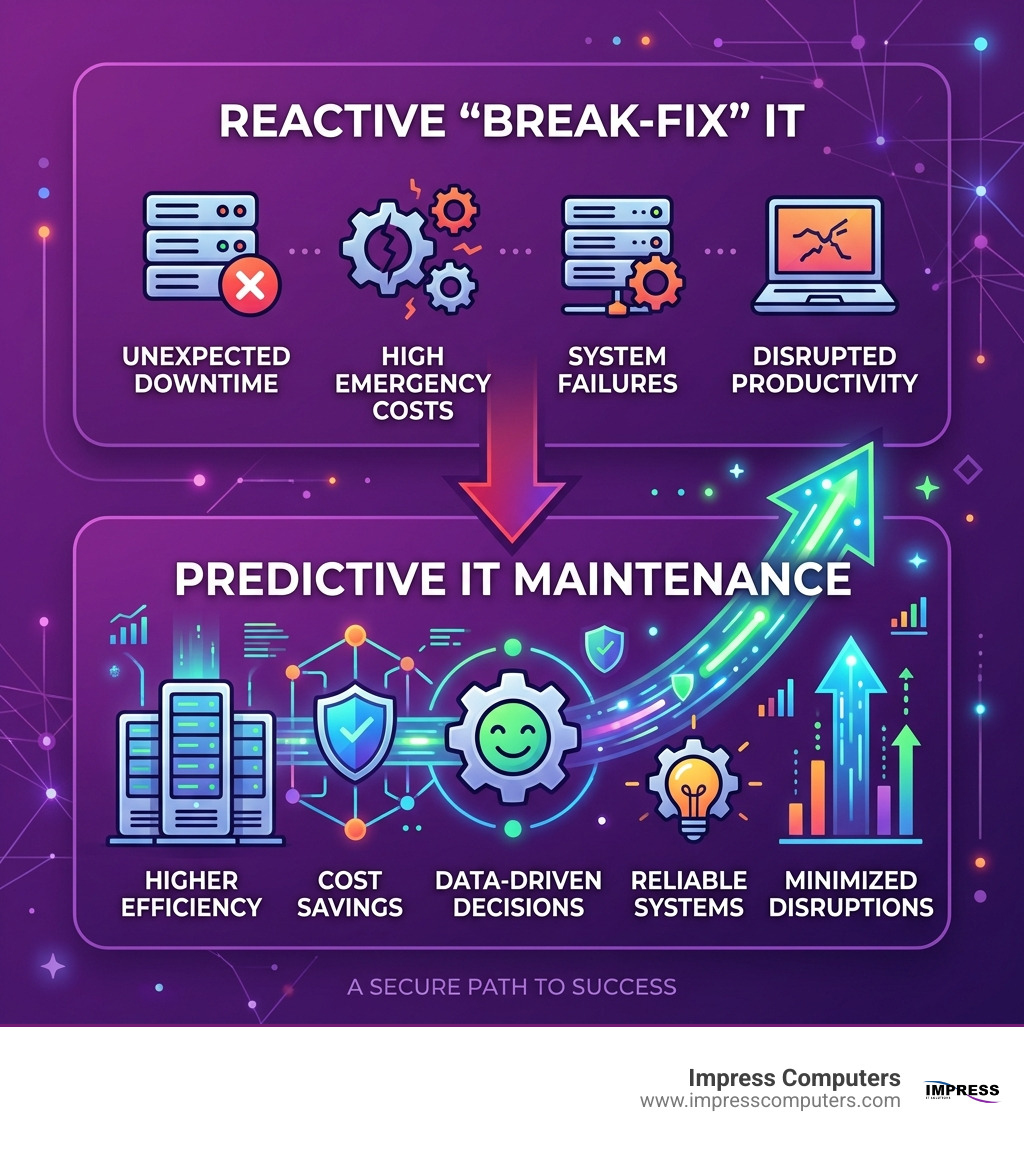
To understand why predictive maintenance IT services are the gold standard, we have to look at where we started. The Deloitte progression of maintenance strategies shows a clear evolution from basic “fix it when it breaks” to advanced “predict and prevent.”
| Model | Strategy | Timing | Risk |
|---|---|---|---|
| Reactive | Fix it when it breaks | After failure | High downtime, high cost |
| Preventive | Scheduled maintenance (like an oil change) | Calendar-based | Over-maintenance, still misses some failures |
| Condition-Based | Fix based on sensor alerts | When thresholds are hit | Better, but can be manual and time-consuming |
| Predictive | AI predicts failure before it happens | Exactly when needed | Lowest risk, maximum efficiency |
Many organizations are now adopting a hybrid approach to asset maintenance, combining real-time condition monitoring with predictive analytics to cover both critical and non-critical assets.
Limitations of Preventive Maintenance
Preventive maintenance was a step in the right direction, but it’s flawed. It’s based on time or usage estimates—like changing your car’s oil every 5,000 miles regardless of how you drive. In IT, this means replacing hard drives every three years or rebooting servers every Sunday night.
The problem? You often end up replacing perfectly good parts (over-maintenance) or, worse, a part fails on day 30 of a 60-day cycle. This leads to unnecessary costs and labor-intensive schedules. While we still believe in The Role of Software Updates in Keeping Your Business Running Smoothly, doing them blindly without checking the “health” of the system first is an outdated way of working.
Why Predictive Maintenance Is Superior
Predictive maintenance acts as an early warning system. Instead of waiting for a calendar date, we use live data to perform just-in-time repairs.
According to Cisco, this data-driven insight allows businesses to optimize the lifespan of their equipment. If a server in your Cypress office is running cool and efficiently, we leave it alone. If a similar server in Fulshear shows signs of fan degradation, we fix it immediately. This surgical precision is what keeps our 99.9% uptime guarantee alive.
How to Implement Predictive Maintenance in Your IT Environment
Transitioning to predictive maintenance IT services isn’t an overnight switch, but it’s faster than you might think. We follow a structured path to ensure your Houston business sees value quickly.
- Asset Identification: We start by cataloging your most critical systems. What would hurt the most if it went down? Usually, it’s your servers, ERP systems, or primary network switches.
- Data Collection & Sensor Integration: We deploy software agents and IIoT sensors that monitor everything from vibration and heat to data throughput.
- Establishing Baselines: The AI needs a week or two to learn what “normal” looks like for your specific business.
- Pilot Programs: We often start with one department or one specific type of asset (like your backup systems) to prove the model before scaling up.
The goal is Predicting and proactively resolving service outages so that your IT support becomes essentially invisible.
Real-World Use Cases for Predictive Maintenance IT Services
What does this look like in the wild? Here are a few ways we use these tools for our Texas clients:
- Server Hardware: We monitor CPU temperature trends. If we see a 5-degree increase over a week despite no change in workload, we know a cooling fan is dying or dust has blocked an intake. We fix it before the server throttles or crashes.
- Network Latency: In manufacturing, even a few milliseconds of delay can mess up automated floor equipment. We track packet loss patterns to identify a failing cable or a port on a switch before it stops communicating entirely. We know The Hidden Cost of Downtime in Manufacturing can be devastating, so we prioritize these signals.
- Storage R/W Errors: Hard drives rarely just “die.” They usually start having small, recoverable errors first. Our systems catch these “quiet” errors and alert us to clone the drive to a new one before the data is lost.
- API Outage Prevention: For our clients in banking and finance, APIs are the lifeblood of their transactions. Predictive tools can give us a 30-minute head start on an API degradation, allowing us to reroute traffic or restart services before the “Service Unavailable” errors start hitting your customers.
Intelligent Ticket Management and Routing
Predictive IT isn’t just about hardware; it’s about the “Service” in IT Service Management (ITSM). When an issue is detected, the AI categorizes it, sets its priority, and routes it to the right expert instantly.
Using natural language processing, the system can read incoming alerts and point to the underlying cause of a problem. If five people in your Missouri City office report “slow internet,” the AI realizes they are all connected to the same aging access point and creates a single high-priority ticket for that specific hardware, rather than five separate “internet” tickets. This automated root cause analysis saves hours of troubleshooting time.
Overcoming Adoption Challenges and Measuring Success
While the benefits are clear, some businesses hesitate. Common hurdles include data quality (the “garbage in, garbage out” rule) and the complexity of integrating new tools with legacy systems.
However, the payoff is worth it. When you implement these systems, you reduce the hours your team spends on repetitive, low-value “firefighting” tasks. This frees up your staff—and ours—to focus on projects that actually grow your business.
Trust in AI is another factor. We don’t just hand the keys to a robot. We use AI as a high-powered assistant that provides a practical guide to proactive support, but the final decisions and high-level repairs are always handled by our expert technicians.
Key Metrics for ROI
How do you know it’s working? We track several key metrics:
- Mean Time Between Failures (MTBF): This should go up. We want your equipment to run longer without issues.
- Maintenance Costs: While there is an upfront investment, your emergency repair bills and “rush shipping” costs for parts should drop significantly.
- System Uptime: We aim for that 99.9% mark.
- Revenue Protection: By calculating your “cost per hour of downtime,” you can see exactly how much money a single prevented outage saved you.
Predictive IT prevents problems instead of just reacting to them, which leads to higher client satisfaction and a much more peaceful office environment.
Frequently Asked Questions about Predictive IT
How much downtime can predictive maintenance actually prevent?
Research shows that predictive maintenance IT services can slash downtime by up to 45% and reduce total infrastructure failures by as much as 73%. By catching the “quiet” signs of trouble—like a server’s memory usage creeping up by 2% every day—we can resolve the issue during your lunch break or after hours, ensuring your business never misses a beat.
How long does it take to see value from predictive maintenance?
This is the best part. While traditional software implementations can take months, “Predictive Maintenance as a Service” can be set up in as little as 2 weeks. Because the AI starts analyzing your data from day one, you begin seeing value almost immediately. You don’t need a 18-month roadmap to start preventing crashes.
Conclusion
The days of “break-fix” IT are numbered. For businesses in Houston, Katy, and Sugar Land, the competitive edge comes from stability and efficiency. By embracing predictive maintenance IT services, you aren’t just fixing computers; you’re protecting your revenue, your reputation, and your sanity.
At Impress Computers, we specialize in bringing these advanced technologies to the manufacturing, construction, and professional sectors across Texas. With our 15-minute response guarantee and 99.9% uptime commitment, we make sure your technology works for you—not the other way around.
Ready to stop playing firefighter and start growing your business? More info about Houston IT support services is just a click away. Let’s build a more predictable future for your business together.
