

Why Network Security Consulting Is the Smartest Investment Your Business Can Make Right Now
Network security consulting helps organizations identify vulnerabilities, design secure infrastructure, and stay ahead of cyber threats — without the cost of building a full in-house security team.
Here’s what network security consultants typically do:
- Assess your risks — map your network, find weak points, and prioritize what needs fixing
- Design your defenses — firewalls, segmentation, Zero Trust architecture, and secure cloud connectivity
- Test your security — penetration testing, vulnerability scans, and policy audits
- Keep you compliant — align your systems with NIST, ISO 27001, HIPAA, PCI, and other standards
- Respond to incidents — contain breaches fast and help you recover with minimal downtime
Cybersecurity threats are growing faster than most internal IT teams can keep up with. Attackers are using AI to move quicker and hit harder. And for businesses in industries like manufacturing, construction, banking, and legal services, a single breach can mean lost contracts, regulatory fines, and days of costly downtime.
The good news? You don’t have to face it alone.
I’m Roland Parker, founder and CEO of Impress Computers — a managed IT and cybersecurity firm I’ve been building since 1993 to help Houston businesses stay secure, compliant, and productive. My experience in network security consulting spans construction, manufacturing, and professional services firms that simply can’t afford downtime or data exposure.
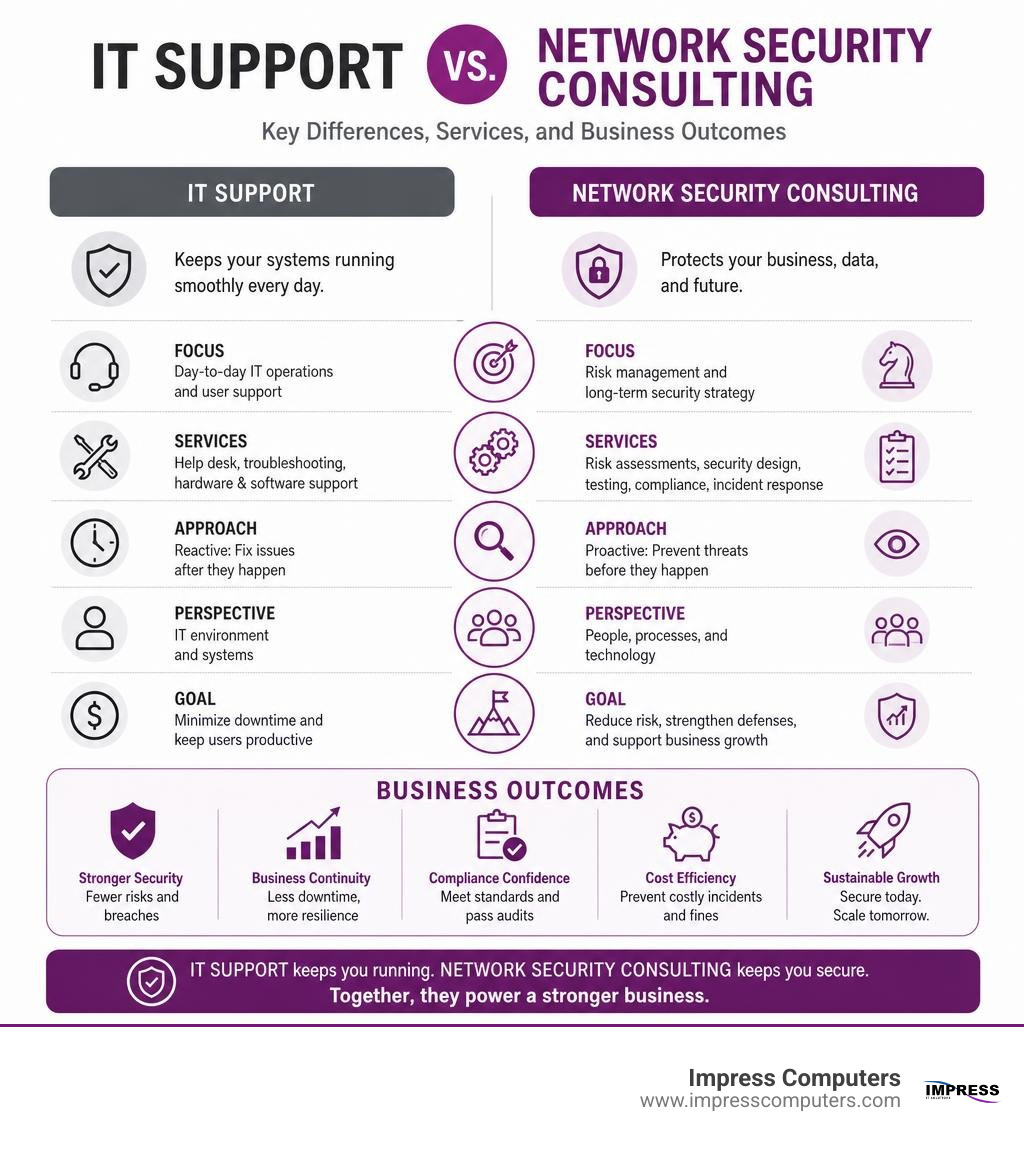
Easy network security consulting glossary:
What is Network Security Consulting?
Many business owners ask us: “We already have an IT guy who keeps our printers running and sets up our emails. Isn’t that enough?”
While basic IT support is essential for day-to-day operations, it is fundamentally different from dedicated network security. Think of general IT support as the team that designs and builds your house, ensuring the plumbing works and the lights turn on. Network security consulting, on the other hand, is the team of security architects who install the deadbolts, set up the motion-activated cameras, build a secure perimeter fence, and monitor the property for sophisticated intruders.

When we talk about network security, we are looking specifically at the pathways, hardware, and protocols that transport your business data. This includes your routers, switches, firewalls, wireless access points, and cloud connectivity pipelines. A consultant specializing in this field makes sure that your data cannot be intercepted, that unauthorized users cannot slip into your network, and that malware cannot spread laterally from a single compromised laptop to your entire database.
If you are new to these concepts, reading our Introduction to Network Security is a great place to start. It breaks down the foundational building blocks of how data moves safely across your organization.
Core Services Offered in network security consulting
When you partner with a consultant, they don’t just guess where your weak spots are. They use a structured suite of services to map out, analyze, and harden your defenses:
- Vulnerability Assessments: This is a comprehensive, non-disruptive scan of your network. We identify outdated firmware, unpatched software, open ports, and expired certificates. It gives us a clear baseline of your current security posture.
- Penetration Testing: Often called “ethical hacking,” this is where our team actively tries to break into your network using the same tactics, techniques, and procedures (TTPs) as real-world cybercriminals. If we can get in, we show you exactly how we did it so we can patch the gap before the bad guys find it.
- Firewall Design and Optimization: Firewalls are your first line of defense. However, an improperly configured firewall is about as useful as a screen door on a submarine. We audit your firewall rulesets, clean up outdated policies, and implement Next-Generation Firewall (NGFW) features like deep packet inspection and intrusion prevention.
- Network Topology Mapping and Asset Discovery: You cannot protect what you do not know exists. We catalog every single device connected to your network—from servers and workstations to smart thermostats and warehouse scanners—and map out how traffic flows between them.
- Security Audits and Policy Reviews: We evaluate your internal security rules against industry standards like the CISA Cyber Essentials. This ensures your staff is following best practices for password management, access control, and incident reporting.
Whether you need specialized Network Security Services Sugar Land Texas, localized Network Security Services Cypress Texas, or comprehensive Network Security Services The Woodlands Texas, a professional consultant tailors these core services to the unique physical and digital layout of your business. Objective third-party testing and regular audits are essential to uncover deep-seated architectural vulnerabilities before they can be exploited.
Frameworks, Standards, and Modern Architectures
A great network security consultant never relies on gut feelings. Instead, they ground their strategies in globally recognized frameworks. This structured approach ensures that your defenses are systematic, repeatable, and capable of standing up to modern audits.
- NIST Special Publication 800-53: Developed by the National Institute of Standards and Technology, this is the gold standard for security controls. It provides a massive catalog of guidelines designed to protect organizational assets and privacy.
- MITRE ATT&CK Framework: This is a globally accessible knowledge base of adversary tactics and techniques based on real-world observations. We use it to simulate realistic cyberattacks and ensure your firewall and detection systems are actually configured to block the exact methods hackers use today.
- ISO 27001: This international standard details how to manage information security risks through a systematic Information Security Management System (ISMS). Achieving alignment with ISO 27001 is a massive competitive advantage for businesses looking to win enterprise contracts.
For businesses in highly regulated fields like banking, CPA firms, and healthcare, staying compliant with these frameworks isn’t just a good idea—it is the law. Failing to meet regulatory standards can result in catastrophic fines and the loss of your operating licenses. You can learn more about how we help businesses navigate these complex rules on our dedicated Compliance page.
Modern network security consulting also focuses heavily on modern cloud-first architectures like SASE (Secure Access Service Edge) and SSE (Security Service Edge).
In the past, security was “castle-and-moat”—everything inside the office network was trusted, and everything outside was untrusted. But in 2026, your employees are working from home, your data is stored in Microsoft Azure or AWS, and your applications are SaaS-based. SASE and SSE solve this by moving security features (like secure web gateways, cloud access security brokers, and zero-trust network access) directly to the cloud edge. This ensures your remote workforce remains secure no matter where they connect from.
Experienced consultants help organizations map out these exact migrations, ensuring that legacy infrastructure doesn’t leave backdoors wide open during cloud transitions.
Implementing Zero Trust with network security consulting
“Never trust, always verify.” That is the core philosophy behind Zero Trust Architecture (ZTA).
In a traditional network, once an attacker bypasses the perimeter firewall, they have free rein to move laterally across the entire system. They can jump from a compromised reception desk computer straight to your financial database.
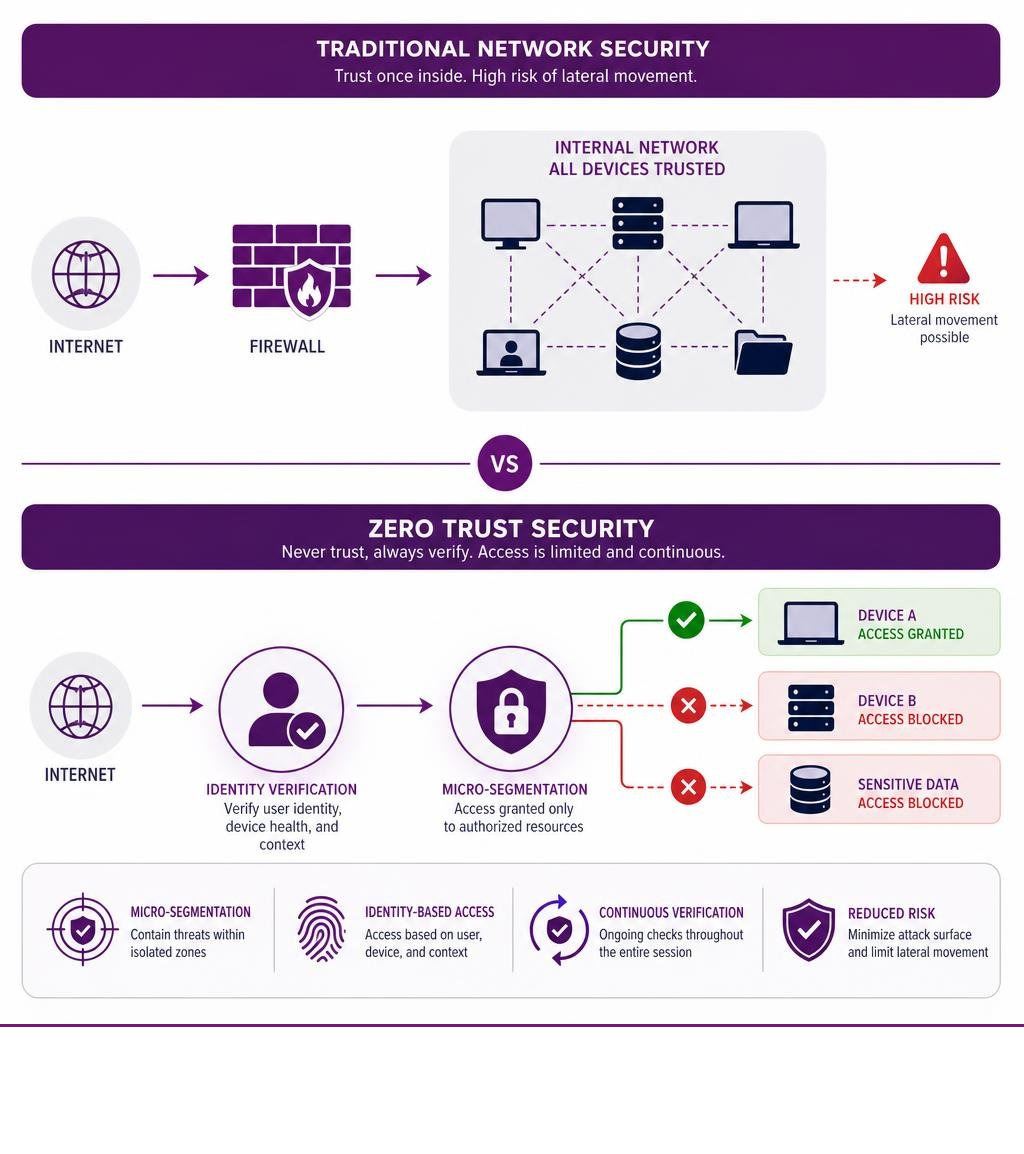
When we implement Zero Trust through our network security consulting engagements, we eliminate this trust assumption entirely. We help you achieve this through:
- Micro-segmentation: We divide your network into small, isolated zones. If a security breach occurs in one zone, it is contained there and cannot spread to the rest of the business.
- Identity-based access: Access to resources is granted based on the identity of the user and the health of their device, not just their location. Just because a laptop is plugged into an office ethernet port doesn’t mean it gets automatic access to your sensitive files.
- Continuous verification: The system constantly verifies user permissions, device compliance, and behavioral patterns throughout the entire session.
To understand the strategic roadmap of this architecture, you can read the official NIST Zero Trust Architecture guidelines. Additionally, enterprise-level guidance from the Zero Trust Advisory – Palo Alto Networks underscores how moving away from legacy VPNs to Zero Trust Network Access (ZTNA) significantly reduces your digital attack surface.
Implementing these advanced controls requires a deep understanding of hardware and protocols. You can explore how we design these modern defenses by visiting our Network Security service page.
The Consultant’s Toolkit: Favorite Tools of the Pros
How do network security consultants actually see the invisible data moving through your office? They use a specialized toolkit of advanced software and hardware designed to dissect network traffic, map assets, and identify vulnerabilities.

Here are the favorite tools our pros use daily:
- Wireshark: The undisputed king of packet analysis. Wireshark lets us capture and interactively browse the traffic running on a computer network. It allows us to look inside the data packets to find hidden malicious traffic, troubleshoot connection drops, and identify unencrypted passwords.
- Nmap (Network Mapper): A powerful open-source tool used for network discovery and vulnerability scanning. We use Nmap to map out your network topology, discover which hosts are active, and identify what operating systems and open ports they are running.
- Nessus: One of the most trusted vulnerability scanners in the world. Nessus scans your systems to find missing patches, software bugs, and misconfigurations, generating a prioritized report of what needs to be fixed immediately.
- Cisco Meraki & ThousandEyes: For modern, cloud-managed networks, we rely heavily on Cisco Meraki dashboards paired with ThousandEyes for deep path monitoring. This combination gives us complete visibility into your cloud connectivity, allowing us to pinpoint whether a slow-down or security anomaly is happening on your local network, with your ISP, or inside the cloud provider’s data center itself.
Understanding how these tools integrate with your day-to-day operations is key to keeping your business safe. We break down this cooperative relationship in our article on The Synergy of IT Support and Network Security.
When configured by certified experts, these professional tools provide the deep visibility needed to secure complex multi-vendor environments and modernize your network architecture.
In-House Teams vs. network security consulting
One of the biggest dilemmas business owners face is deciding whether to hire a full-time, in-house security expert or partner with an external consulting firm.
Let’s look at a realistic comparison:
| Feature | In-House Security Employee | External Network Security Consulting |
|---|---|---|
| Annual Cost | High ($90k – $150k+ salary plus benefits, taxes, and training) | Predictable, scalable monthly retainer or project-based fee |
| Skill Set | Limited to the specific background of the individual hired | Access to a diverse team of specialists (firewall, compliance, cloud, pen-testing) |
| Coverage | 40 hours a week (vulnerable during sick days, vacations, and weekends) | 24/7/365 continuous monitoring and rapid response |
| Turnover Risk | High (if they leave, you lose all institutional security knowledge) | None (the consulting firm retains your network documentation and history) |
| Objectivity | Can be influenced by internal office politics or routine blind spots | Completely unbiased, objective assessment of your vulnerabilities |
The math is simple: hiring an external team gives you access to a massive pool of specialized talent for a fraction of the cost of a single full-time hire. This allows you to offload the security overhead so you can focus entirely on growing your business.
To explore this choice further, take a look at our comprehensive guide on Cyber Security.
Choosing the Right Consulting Partner
If you decide to work with an external consultant, how do you make sure you are choosing the right one? Here are the critical qualifications you should look for:
- Top-Tier Certifications: Ensure the lead architects hold respected, industry-standard certifications. Look for CCIE (Cisco Certified Internetwork Expert)—which is held by fewer than 1% of networking professionals worldwide—and CISSP (Certified Information Systems Security Professional).
- Vendor Neutrality: A great consultant shouldn’t force you into a single hardware ecosystem just because they get a sales commission. They should design solutions that fit your budget and technical requirements, whether that involves Palo Alto, Cisco, Fortinet, or open-source solutions.
- Industry-Specific Expertise: A law firm has very different compliance and data handling needs than a structural steel manufacturing plant. Choose a partner who understands the specific operational realities of your sector.
If you are currently looking at the local talent pool, you can browse Security Consultant jobs in Houston, TX – Indeed to see what qualifications are highly valued in our market. Regular local audits are essential to ensure your business remains compliant and secure against evolving threats.
We provide highly tailored security programs across the Houston metroplex. You can find our specialized local solutions on our dedicated pages:
- Cyber Security Solutions The Woodlands Texas
- Cyber Security Solutions Cypress Texas
- Cyber Security Solutions Brookshire Texas
Ready to talk about securing your business? You can reach out directly to our team at Impress Computers through our Contact Impress Computers page.
Frequently Asked Questions about Network Security
How do consultants balance security with operational uptime?
This is one of the most common concerns business owners have. They worry that implementing strict security measures will slow down their network or prevent employees from doing their jobs.
We address this by using a strict change-management methodology. Any major network changes, firewall updates, or vulnerability patches are scheduled during pre-approved maintenance windows (typically late at night or over the weekend) to ensure zero disruption to your daily operations. We also design high-availability networks with redundant internet connections and failover firewalls, allowing us to maintain our 99.9% uptime promise while keeping your business completely secure.
What certifications should a network security consultant hold?
You should look for a combination of strategic and highly technical certifications:
- CISSP (Certified Information Systems Security Professional): Demonstrates deep knowledge of security architecture, risk management, and operations.
- CCIE (Cisco Certified Internetwork Expert): The gold standard for hands-on, high-level networking engineering.
- CISM (Certified Information Security Manager): Focuses on security governance, program development, and incident management.
How do consultants address emerging challenges like AI governance and IoT?
The threat landscape in June 2026 is vastly different than it was just a few years ago. Today, consultants must tackle:
- Shadow AI: Employees pasting sensitive company data or client contracts into unauthorized public AI tools. We help businesses develop acceptable-use policies and implement Cloud Access Security Brokers (CASB) to block unauthorized AI data uploads.
- IoT (Internet of Things) Security: Smart TVs, connected warehouse sensors, and security cameras are notorious for having weak security. We isolate these devices on their own dedicated, firewalled VLANs so they can’t be used as a stepping stone to your primary servers.
- Remote Workforce Security: Securing home networks is impossible, so we secure the connection instead. We deploy Secure Access Service Edge (SASE) and endpoint detection tools to ensure that a compromised home router doesn’t compromise your corporate database.
Conclusion
At the end of the day, network security isn’t about buying the most expensive firewall or locking down your systems so tightly that your employees can’t work. It’s about building a resilient, reliable, and compliant digital foundation that allows your business to grow with confidence.
At Impress Computers, we’ve spent over three decades helping Houston-area businesses navigate these exact challenges. We specialize in supporting companies in the manufacturing, construction, banking, legal, and CPA sectors across Houston, Katy, Sugar Land, Cypress, The Woodlands, Brookshire, Fulshear, Richmond, Rosenberg, and Missouri City.
We don’t hide behind confusing tech jargon or make excuses. We back our services with a 15-minute response guarantee, a commitment to 99.9% uptime, and practical, practitioner-led solutions designed for your specific industry.
Protect your business, your data, and your reputation before the hackers make the choice for you. Let’s build a secure future together.
If you are ready to experience the peace of mind that comes with enterprise-grade network security and proactive support, visit our IT Support Houston page today to schedule your complimentary network security assessment.
