

Why Katy LLM Security Experts Are Essential for Houston Businesses in 2026
If your business is deploying AI tools and you need Katy LLM security experts, here is a quick answer to help you decide on your next step:
Top reasons to work with a local LLM security expert in Katy, TX:
- Rapid response — Local experts can respond within minutes, not hours, when an AI-related breach or vulnerability is detected.
- Industry-specific compliance — Manufacturing, construction, banking, legal, and accounting firms face unique regulatory requirements that a local expert understands firsthand.
- End-to-end LLM protection — From securing training data to monitoring deployed models, qualified experts cover the full AI lifecycle.
- Regulatory alignment — Experts help you stay compliant with frameworks like the NIST AI Risk Management Framework and the California Consumer Privacy Act (CCPA).
- Proactive threat coverage — As of June 2026, threats range from data poisoning during model training to prompt injection and embedding inversion attacks against live deployments.
Large language models are now embedded in everyday business operations — drafting contracts, analyzing financials, supporting customer service, and processing sensitive data. That creates serious new risks. LLMs are trained on massive datasets, which makes them vulnerable to corrupted training data, adversarial inputs, and attacks that can silently extract private information. According to current security research, even the gradient data shared during distributed model training can be reverse-engineered to reconstruct confidential records.
The threat landscape is continuously evolving. In 2025 alone, researchers documented the first known AI-powered ransomware proof-of-concept, novel prompt injection attacks hidden inside images, and zero-click exploits capable of hijacking AI agents to exfiltrate data — all without user interaction. For a Houston-area business owner, these are not abstract risks. They are live threats that require expert attention now.
I’m Roland Parker, Founder and CEO of Impress Computers, and after more than three decades helping Houston-area businesses build secure, resilient IT infrastructure, I’ve seen how quickly emerging technologies introduce new vulnerabilities — which is exactly why I wrote this guide to help you understand what Katy LLM security experts can do to protect your business. Below is a detailed analysis of what you need to know.
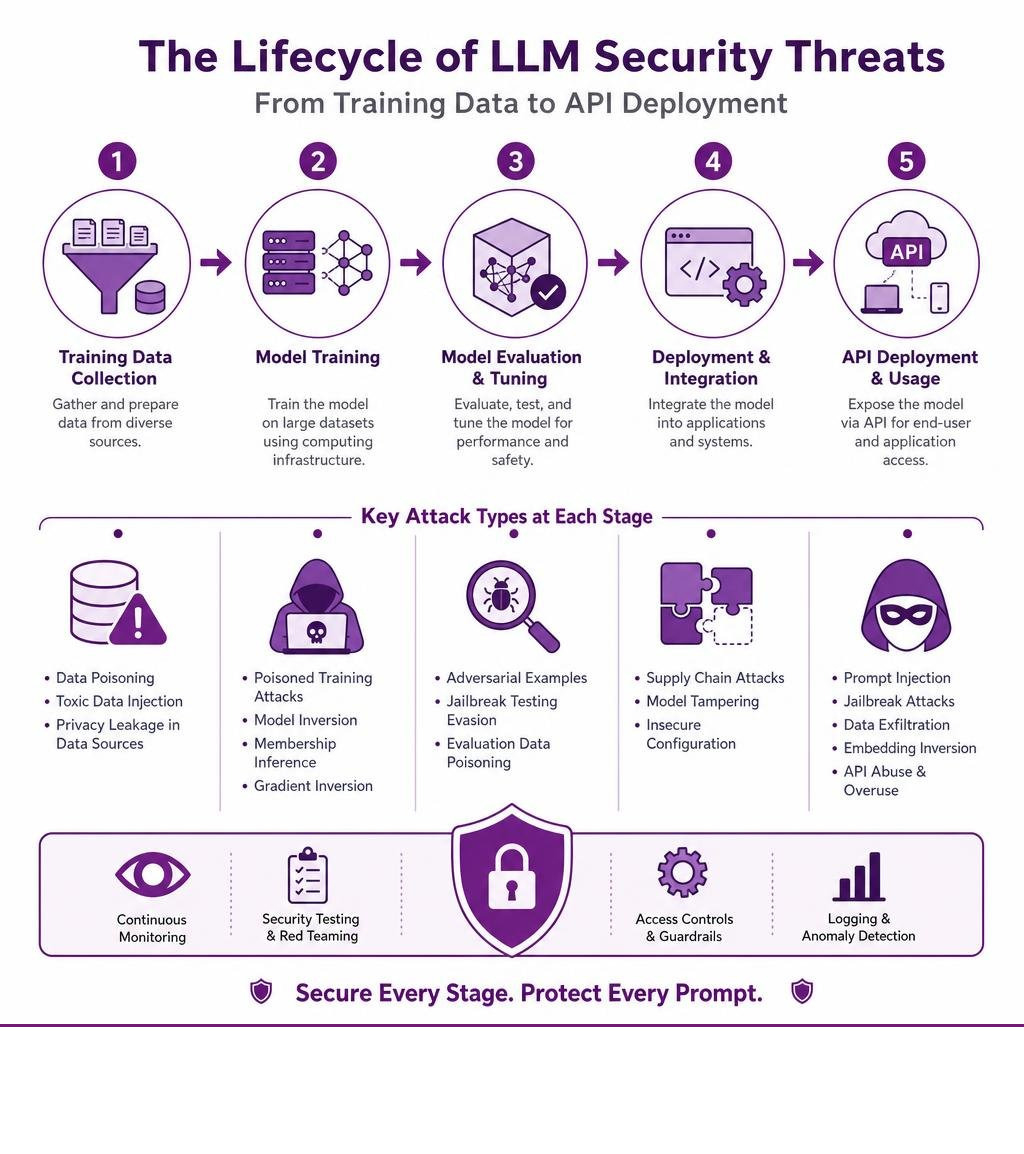
Katy llm security experts word guide:
The Evolving Threat Landscape: Why Partner with Katy LLM Security Experts

As organizations in Katy, West Houston, and surrounding areas integrate Generative AI (GenAI) into their core systems, they open up new, complex attack surfaces. Traditional security tools—such as standard firewalls and signature-based antivirus solutions—are unable to detect the unique vulnerabilities of machine learning models.
When deploying LLMs, businesses are not just exposing standard software code; they are exposing complex, probabilistic neural networks. These networks are susceptible to data leakage, insider threats, and sophisticated model manipulation. A single unauthorized employee using a personal account to process proprietary corporate data can result in massive intellectual property exposure. In fact, security researchers have noted that over 30% of ChatGPT usage and nearly a quarter of Gemini usage occurs through unmonitored personal accounts, bypassing corporate security controls entirely.
To navigate these challenges safely, organizations must understand what is actually worth worrying about. Many businesses focus on highly publicized, theoretical AI doomsday scenarios while ignoring immediate, practical threats like data leakage and compliance failures. For a detailed breakdown of which threats demand your immediate attention, read our analysis on Understanding AI Threats: What is Actually Worth Worrying About.
Furthermore, regulatory compliance is no longer optional. Deployed AI systems must align with regional consumer privacy laws and strict federal guidelines. Partnering with dedicated Katy LLM security experts ensures that your organization can seamlessly translate complex legal requirements into technical controls. This process includes conducting gap analyses against the NIST AI Risk Management Framework and establishing robust data policies to satisfy the California Consumer Privacy Act (CCPA) and other evolving data privacy standards.
Understanding LLM Vulnerabilities: Causative vs. Exploratory Attacks
To defend against LLM-specific threats, security teams must categorize attacks based on the model’s lifecycle. Threat modeling divides these vectors into causative attacks (occurring during the training or fine-tuning phase) and exploratory attacks (occurring at inference time when the model is active).
| Attack Type | Lifecycle Phase | Primary Vectors | Mitigation Strategy |
|---|---|---|---|
| Causative (Training-Time) | Model Training & Fine-Tuning | Backdoor insertion, data poisoning, split-view poisoning, gradient leakage | Differential privacy, strict data curation, cryptographic data lineage |
| Exploratory (Inference-Time) | Model Deployment & Operation | Prompt injection, adversarial examples, model inversion, embedding inversion | Input/output sanitization, perplexity-based filtering, API rate limiting |
Causative Attacks: Backdoors and Data Poisoning
Causative attacks manipulate the model’s behavior by altering its training data or the training process itself.
- Backdoor Attacks: In a backdoor attack, an adversary injects a hidden trigger into the training dataset. When the deployed model encounters this specific trigger (which could be a unique phrase or a specific image pattern), it executes a malicious payload or changes its classification output with high confidence. These can be input-triggered, prompt-triggered, instruction-triggered, or demonstration-triggered.
- Data Poisoning: Attackers introduce corrupt or misleading data into the training pool. Advanced variations include split-view poisoning and front-running poisoning, which exploit how web-scale datasets are indexed and collected. By modifying web resources right before they are scraped, attackers can poison models without needing direct access to the training infrastructure.
- Gradient Leakage: During collaborative or distributed training, participants share gradients rather than raw data. However, gradient leakage attacks allow an adversary to reconstruct private training data with high accuracy from these publicly shared gradients.
Understanding these vectors is critical for secure development. Organizations should refer to the OWASP Top 10 for LLM Applications to establish rigorous controls against training-time data manipulation.
Exploratory Attacks: Prompt Injection and Data Extraction
Exploratory attacks target already trained, deployed models. Rather than altering the underlying parameters, the attacker crafts specific inputs to bypass security controls or extract confidential information.
- Prompt Injection: This occurs when an attacker manipulates the prompt to override the system instructions. Direct prompt injections hijack the conversation, while indirect prompt injections hide malicious instructions within external resources (such as a webpage or document) that the LLM is asked to summarize.
- Adversarial Examples: Minor, often imperceptible perturbations in input text or images can cause the model to misclassify data or output harmful content with high confidence.
- Embedding Inversion: This attack allows adversaries to recover the original, private input text from vector embeddings. By maximizing the cosine similarity between candidate text embeddings and target embeddings, attackers can reconstruct sensitive documents.
- Token Manipulation: Vulnerabilities such as TokenBreak allow attackers to bypass guardrails by splitting malicious words into sub-tokens, tricking the safety filters while still forcing the underlying model to execute the command. Learn more about this specific threat in our report: Impress IT Solutions Warns West Houston Businesses About TokenBreak: A New AI Security Threat.
Implementing Robust Defense Mechanisms for Enterprise AI

Defending an enterprise AI system requires a multi-layered approach. Security teams must implement both prevention-based defenses to block attacks before they reach the model and detection-based defenses to identify anomalous behavior in real time. For a comprehensive look at keeping your models secure, read our guide on Mitigation Strategies: Controlling and Securing Enterprise AI.
Prevention-Based Defenses: Differential Privacy and Fine-Tuning
Prevention-based strategies focus on hardening the model and its data pipeline against exploitation.
- Differential Privacy: This mathematical framework provides strict guarantees that individual training contributions cannot be distinguished, even by adversaries with extensive external knowledge. By adding controlled noise during the training phase, differential privacy prevents gradient leakage and membership inference attacks.
- Secure Fine-Tuning: Restricting fine-tuning to highly curated, verified datasets prevents the introduction of backdoors.
- Private vs. Open-Source Deployments: Publicly hosted, open-source models often expose organizations to data-leakage risks. Security-conscious businesses in West Houston are increasingly shifting to dedicated private AI environments to keep their data isolated. Discover why this transition is critical by reading Private AI vs Open Source AI: Why Security-Conscious Businesses in West Houston Choose Hatz Private AI from Impress IT Solutions.
To ensure these prevention strategies meet enterprise-grade requirements, they should be aligned with the ISO/IEC 27001 Information Security Management standard, which establishes a framework for managing information risks systematically.
Detection-Based Defenses: Perplexity and Input Sanitization
When prevention is not enough, detection-based mechanisms act as a critical safety net.
- Perplexity-Based Detection: This technique analyzes incoming prompts for unusual or unnatural language patterns. High-perplexity inputs often indicate prompt injection attempts or adversarial perturbations, allowing the system to block them before they reach the LLM.
- SmoothLLM: This defense method is highly compatible with both black-box and white-box models. It functions without requiring retraining by randomly perturbing input copies and aggregating the model’s outputs to detect and neutralize adversarial prompt injections.
- Input and Output Sanitization: Implementing strict validation layers ensures that sensitive data (like social security numbers or API keys) is redacted from both incoming prompts and outgoing model responses.
To maintain a resilient defense posture, organizations should implement continuous validation. Aligning your detection strategies with the NIST Zero Trust Architecture (SP 800-207) ensures that every model interaction is continuously verified, authenticated, and authorized.
How Katy LLM Security Experts Secure Your AI Tech Stack
Implementing these advanced defense mechanisms requires specialized knowledge. Our team at Impress Computers provides localized, hands-on expertise to help businesses across Katy, Cypress, Fulshear, and Houston secure their AI implementations.
We begin by assessing your current infrastructure to identify hidden vulnerabilities. If you are unsure where your AI deployment stands, read Why Your Business Needs an AI Safety Compliance Audit Right Now. From there, we help you integrate the correct security controls into your specific software stack. For a detailed guide on selecting the right services, explore The Best AI Security Compliance Services for Your Tech Stack.
Practical Steps for Deploying Secure Large Language Models
Securing your AI technology is only one part of the challenge; human factors and governance are equally important. Organizations must establish clear internal policies, manage data access, and conduct regular employee training.
To prevent employees from inadvertently leaking proprietary information through unauthorized AI tools, businesses must implement structured training programs. Learn how to safeguard your corporate assets by reading Empower Your Team: Protect Company Data from GenAI Risks with Impress IT Solutions in West Houston.
Additionally, building a culture of AI safety involves continuous education on prompt engineering, data handling, and model limitations. Discover our comprehensive training resources at Mastering AI to ensure your workforce is prepared to use these tools responsibly.
Developing an AI Safety Compliance Framework with Katy LLM Security Experts
Building a robust compliance framework requires a balance between operational efficiency and risk mitigation. Our team works with you to design a tailored framework that includes:
- Continuous Monitoring: Real-time auditing of LLM inputs, outputs, and agent actions.
- Access Controls: Restricting model access based on roles and verifying data lineage.
- Incident Response Planning: Establishing rapid-response protocols specifically for AI-related security events.
For practical advice on balancing innovation with security, review our guide on Getting the Most Out of AI While Minimizing the Risks.
Frequently Asked Questions About LLM Security
What are the primary security risks when deploying LLMs in enterprise environments?
The primary risks include data leakage (confidential data being exposed to unauthorized users or public models), prompt injection (manipulating the model to bypass safety guardrails), unauthorized API access, insider threats from unmonitored personal accounts, and model theft or reverse-engineering.
How do Katy LLM security experts mitigate data poisoning during model training?
We implement strict data sanitization pipelines, enforce cryptographic data lineage to verify training sources, and apply mathematical techniques like differential privacy to ensure that individual data points cannot be extracted or targeted during the training process.
Why is a local security partner essential for Houston-area businesses using AI?
A local partner like Impress Computers provides a 15-minute response guarantee, deep familiarity with regional compliance standards, and hands-on, on-site support across Katy, Houston, and surrounding areas. This ensures your business receives immediate assistance during a security incident rather than waiting on a remote vendor.
Conclusion
Deploying Large Language Models can revolutionize your business operations, but it also introduces sophisticated security challenges that require professional oversight. At Impress Computers, we provide managed IT services and expert cybersecurity support tailored specifically for Houston-area businesses in the manufacturing, construction, banking, legal, and CPA sectors.
We back our services with a 15-minute response guarantee, 99.9% uptime, and industry-specific expertise to keep your business secure and compliant. If you are ready to implement a secure, managed AI solution for your organization, explore our Hatz AI Training & Implementation Program and let our team help you build a resilient AI infrastructure.
