

Why Machine Learning Security Is a Business-Critical Priority
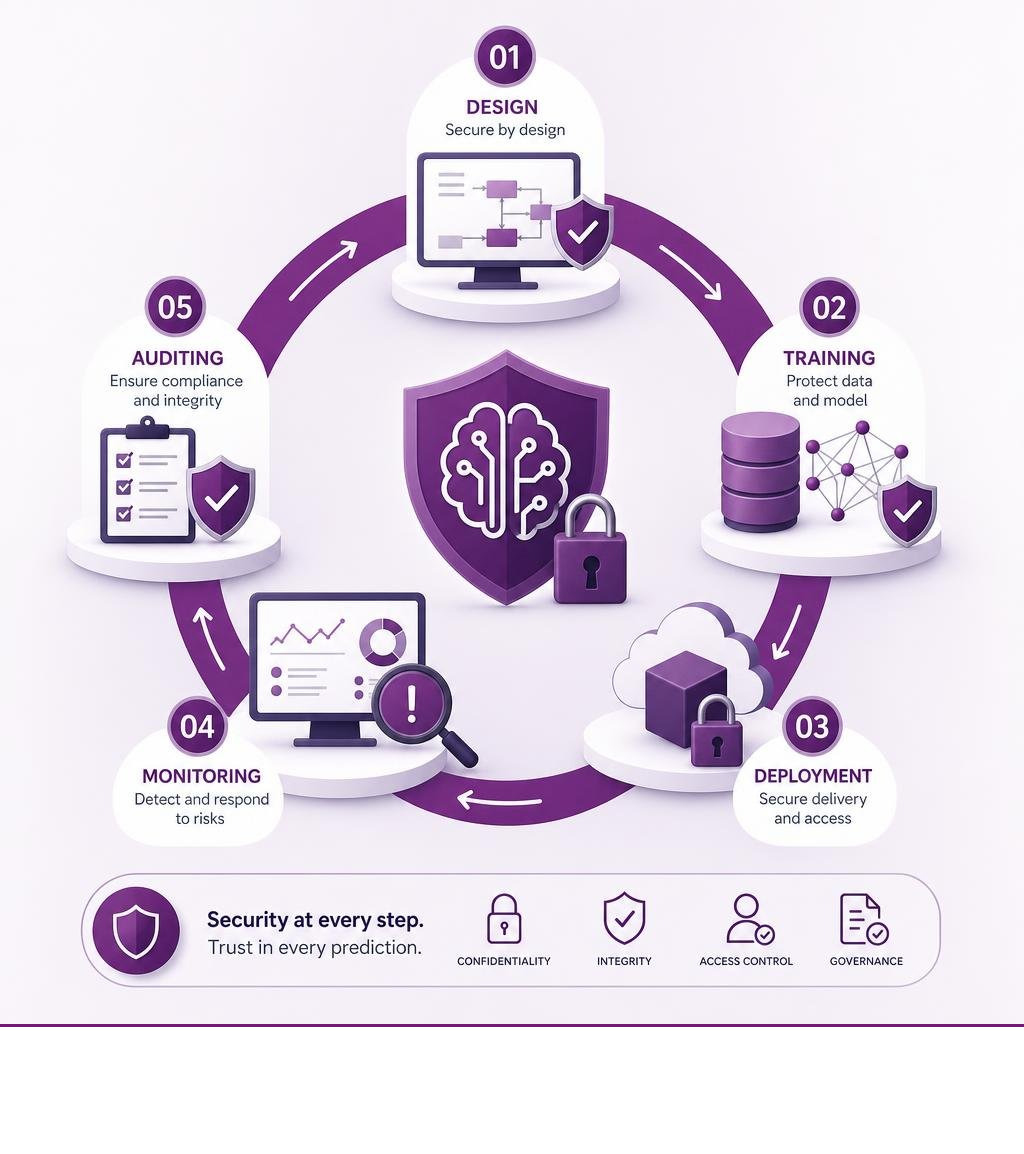
Machine learning security refers to the practice of protecting AI and ML systems from attacks, data manipulation, and privacy breaches — across every stage of the model lifecycle.
If you’re evaluating services for secure ML deployment and auditing, here are the key areas to look for:
- Data protection — encryption, anonymization, and access controls for training data
- Attack defenses — protection against poisoning, evasion, model theft, and inference attacks
- Audit and compliance tools — audit trails, GDPR/HIPAA/CCPA compliance checking, and model versioning
- Deployment security — secure APIs, role-based access, and monitored model serving
- Ongoing monitoring — data drift detection, continuous retraining, and incident response
Machine learning is now embedded in spam filters, fraud detection, medical diagnostics, and industrial automation. That makes it a high-value target.
Here’s the uncomfortable truth: the same adaptability that makes ML powerful also makes it vulnerable. Researchers have shown that even 1% contaminated training data can cause a spam filter to misclassify legitimate email at a 10% false positive rate — effectively rendering it useless. Attackers don’t need to break your infrastructure. They just need to quietly corrupt your data.
The threat isn’t theoretical. Real-world attacks have caused autonomous vehicles to misread stop signs, chatbots to produce harmful outputs within 24 hours of launch, and face recognition systems to be fooled by printed glasses frames.
I’m Roland Parker, founder and CEO of Impress Computers, where I’ve spent over 30 years helping Houston-area businesses in manufacturing, construction, banking, and legal services build secure, scalable IT systems — including guiding organizations through the growing complexity of machine learning security. In the roundup below, I’ll walk you through the best services available today for deploying and auditing ML systems safely.
Understanding the Taxonomy of Machine Learning Security
To defend a system, you first have to understand how it can be broken. In machine learning security, we use a specific taxonomy to categorize threats. This isn’t just academic jargon; it’s a roadmap for defense. This framework, largely established in 2010 and refined by organizations like NIST, looks at three independent dimensions: Influence, Security Violation, and Specificity.
The Influence Dimension: Causative vs. Exploratory
This dimension asks: When is the attacker messing with the system?
- Causative Attacks: These happen during the training phase. The attacker “influences” the learning process by injecting malicious data into the training set. If they control even a small fraction of your data, they can shift the model’s decision boundary.
- Exploratory Attacks: These happen after the model is trained. The attacker doesn’t change the model; they just “explore” it to find blind spots. Think of a spammer sending thousands of test emails to see which keywords trigger the filter and which don’t.
The Security Violation Dimension: Integrity vs. Availability
This asks: What is the attacker trying to break?
- Integrity Attacks: The goal here is to let “bad” things through without being noticed. For example, a virus that disguises itself to look like a harmless file. The system still works for everyone else, but it fails to catch the specific threat.
- Availability Attacks: The goal is to cause so many false positives that the system becomes unusable. Imagine a “rogue filter” that starts blocking all your legitimate client emails. You’d eventually have to turn the filter off, leaving you wide open.
The Specificity Dimension: Targeted vs. Indiscriminate
Finally, we look at the “who.” A Targeted attack focuses on a specific instance (e.g., making sure one specific malware file is never detected). An Indiscriminate attack is a “shotgun” approach, aiming to degrade the model’s overall accuracy across the board.
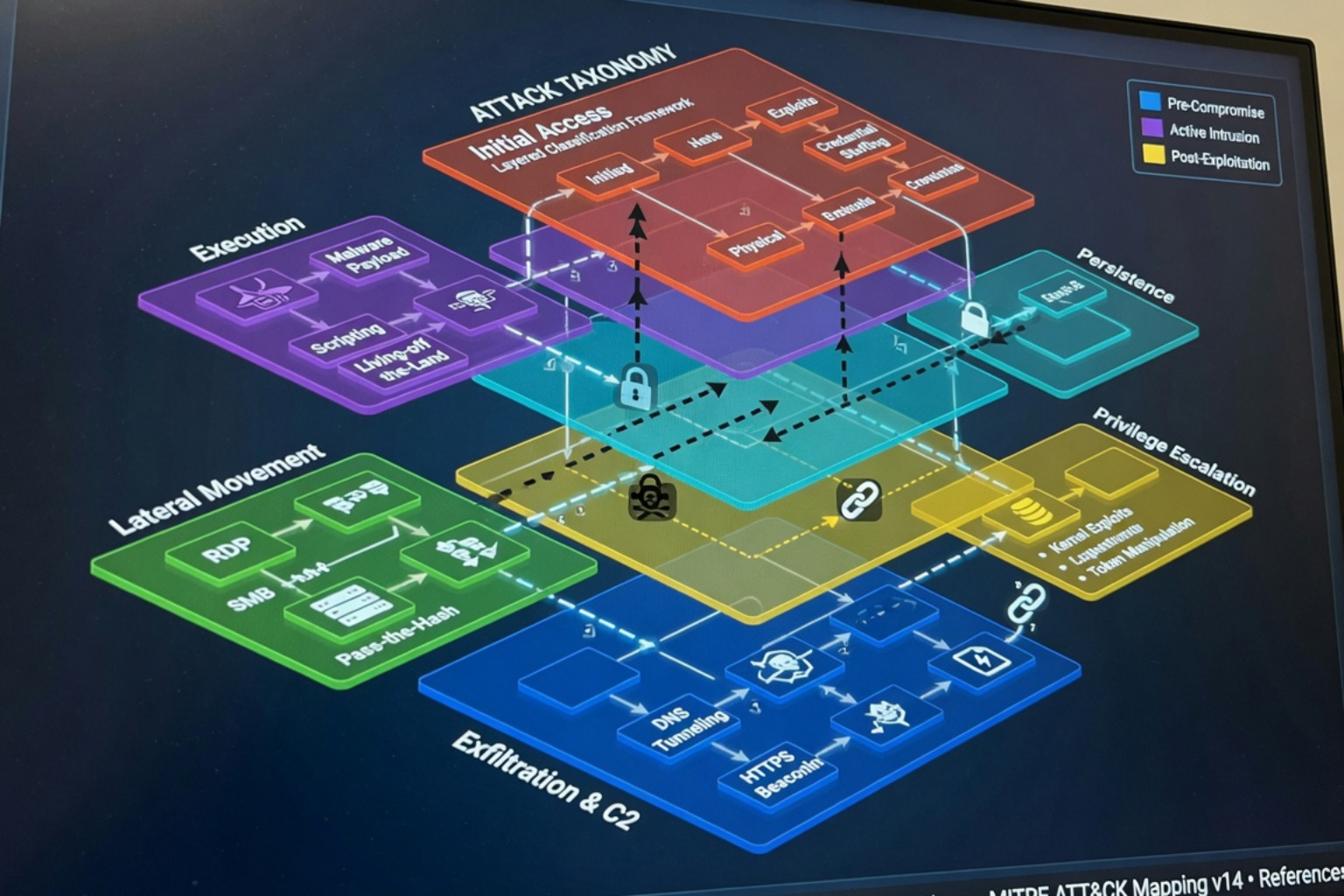
By modeling these as an adversarial game, we can use cost functions to determine how much effort an attacker must exert versus the potential reward. This game-theoretic approach is at the heart of the NIST AI Risk Management Framework Playbook, which helps us structure our defenses based on the most likely “moves” an adversary might make.
Critical Attacks and Vulnerabilities in Modern ML Systems
Modern ML systems face a “Top 10” list of risks that go far beyond traditional hacking. While a standard server might face SQL injection, an ML model faces data poisoning and model theft.
| Attack Vector | Type | Goal | Real-World Example |
|---|---|---|---|
| Data Poisoning | Causative | Corrupt the model during training | Injecting “good” words into spam to retrain the filter |
| Evasion (Adversarial Examples) | Exploratory | Fool the model during inference | Adding “noise” to a stop sign so an AI sees a speed limit |
| Model Inversion | Privacy | Extract sensitive training data | Reconstructing a patient’s face from a medical AI |
| Membership Inference | Privacy | Determine if a record was in the training set | Checking if a specific person’s data was used in a study |
The OWASP Machine Learning Security Top 10 highlights that these vulnerabilities often stem from the statistical nature of ML. For instance, in Probably Approximately Correct (PAC) learning, an attacker can prevent a learner from succeeding if they control a fraction of errors (β) greater than or equal to ε/(1 + ε). In plain English: if the attacker controls enough of the training data, the model cannot learn correctly.
We saw this clearly in studies of SpamBayes, a popular Bayesian filter. Attackers used “dictionary attacks”—filling emails with thousands of common words—to force the filter to associate normal language with spam. This rendered the filter useless because it started blocking legitimate business correspondence. Even more dangerous are “focused attacks,” where an attacker targets specific tokens (like a company name) to ensure emails from that source are always blocked.
Beyond the data itself, we must worry about AI supply chain risks. If you download a pre-trained model from a public hub, how do you know it hasn’t been “backdoored”? A model could perform perfectly on 99.9% of tasks but fail catastrophically when it sees a specific “trigger” word or image.
Proven Defense Strategies for Adversarial AI
Defending against these attacks requires a “defense-in-depth” strategy. We don’t just rely on one firewall; we secure the data, the training process, and the deployment environment.
One of the most effective methods is adversarial training. This involves intentionally creating “adversarial examples” (malicious inputs) and including them in the training set with the correct labels. It’s like giving the AI a vaccine; you expose it to a weakened version of the threat so it knows how to respond when the real thing arrives.
Tools like the Trusted AI Adversarial Robustness Toolbox allow developers to test their models against dozens of known attack types. Other strategies include:
- Feature Selection: Using only the most robust data points that are hard for an attacker to spoof.
- Randomization: Adding a bit of “noise” to the classifier’s output so an attacker can’t easily “probe” the model to find the decision boundary.
- Moving Target Defense: Regularly updating or changing the model parameters so the attacker is always shooting at where the target used to be.
Implementing RONI for Machine Learning Security
For businesses in Houston, especially those in the banking or legal sectors, the Reject On Negative Impact (RONI) defense is a game-changer for training data integrity.
RONI works by testing every new piece of training data before it’s allowed into the “brain” of the model. The system asks: “If I add this data, does my overall accuracy go down?” If a batch of data causes a significant spike in false positives—greater than five standard deviations from the median—it is rejected.
In experiments with SpamBayes, RONI was incredibly effective. It successfully rejected 100% of dictionary attacks. While it does have a small performance trade-off (it might incorrectly reject about 2.8% of legitimate “ham” messages), that is a small price to pay for preventing a total system collapse. This is particularly vital when dealing with zero-day vulnerabilities in ML, where attackers use previously unknown methods to corrupt your data.
Privacy-Preserving Techniques and Machine Learning Security Auditing
When we handle sensitive data for CPA firms or medical offices in Katy or Sugar Land, privacy is non-negotiable. This is where techniques like Differential Privacy and Federated Learning come in.
- Differential Privacy: Adds mathematical noise to the data so that the model learns general patterns without “memorizing” individual records. This prevents membership inference attacks.
- Federated Learning: Allows the model to be trained across multiple devices (like employee laptops) without the raw data ever leaving those devices.
- K-Anonymity and Data Masking: Essential for compliance with GDPR, HIPAA, and CCPA.
Using tools like SecureML Documentation can help automate these compliance checks. An audit trail is also vital; you need to know exactly which data was used to train which version of the model. If a model starts acting strangely, you need to be able to “roll back” to a known-good version.
Best Practices for MLSecOps and Deployment
Securing machine learning isn’t a one-time setup; it’s an ongoing process called MLSecOps. This integrates security into the entire machine learning pipeline, from data collection to production.
- Maintain High-Quality Data: Secure your collection points. If you’re a law firm using AI to improve paralegal efficiency, ensure the documents being fed into the system haven’t been tampered with.
- Monitor for Data Drift: The world changes. If your model was trained on 2023 data but it’s now 2025, the patterns might be different. Continuous monitoring helps you spot when a model is becoming less accurate and needs retraining.
- Secure Your APIs: Most ML models are accessed via APIs. Use rate limiting to prevent attackers from “query mining” your model (sending millions of requests to reverse-engineer it).
- Role-Based Access Control (RBAC): Not everyone in the company needs access to the raw model weights or the full training dataset. Limit access based on the principle of least privilege.
- Model Versioning: Use tools like MLflow or DVC to track changes. As the NCSC Machine Learning Principles suggest, version control is your best friend when an incident occurs.
Frequently Asked Questions about Secure ML
What is the difference between poisoning and evasion attacks?
Poisoning attacks happen during the training phase. The attacker adds bad data to the training set to “brainwash” the model. Evasion attacks happen during the inference phase (when the model is running). The attacker provides a “tricky” input that the model misclassifies, like a piece of malware that looks like a harmless PDF.
How does the RONI defense protect training data?
The Reject On Negative Impact (RONI) defense acts as a gatekeeper. Before any new data is added to the training set, the system performs a trial run. If adding that data significantly hurts the model’s accuracy on a known-good validation set, the data is flagged as malicious and discarded.
Why is data encryption vital for machine learning security?
Data is the “fuel” for ML. If an attacker intercepts your training data in transit or steals it from a server, they can not only steal your proprietary intellectual property but also learn exactly how to craft an attack to bypass your model. Encryption at rest and in transit is the first line of defense.
Conclusion
At Impress Computers, we believe that machine learning security is the foundation of the next generation of business productivity. Whether you are a manufacturing plant in Brookshire looking to automate quality control or a banking institution in Houston needing robust fraud detection, the security of your AI models is just as important as the security of your front door.
We provide managed IT services with a 15-minute response guarantee and 99.9% uptime, ensuring that your ML deployments are not only powerful but resilient against the evolving threat landscape. From the Woodlands to Sugar Land, we help businesses navigate the complexities of AI adoption while maintaining strict compliance and security standards.
Ready to take the next step? You can unlock the power of AI to boost productivity in your business today. If you’re looking for a structured way to get started, check out our AI Training and Implementation Program for a comprehensive three-month rollout that puts security first.
Let’s build a smarter, more secure future for your business together. Give us a call at our Katy office or visit us online to see how we can help you stay ahead of the curve.
