
Why Secure AI Privacy Compliance Is Now a Business-Critical Priority
Secure AI privacy compliance is the practice of embedding data protection, regulatory alignment, and ethical safeguards into every stage of how your organization builds, buys, or uses AI systems.
Here’s what Houston business owners need to know right now:
| What It Covers | Why It Matters |
|---|---|
| Data governance for AI inputs and outputs | Prevents unauthorized use of customer data |
| Regulatory alignment (GDPR, EU AI Act, CCPA) | Avoids fines and legal exposure |
| Privacy-preserving AI techniques | Reduces risk without sacrificing AI performance |
| Supply chain and vendor AI audits | Closes gaps from third-party AI tools |
| Transparency and explainability | Meets regulator and customer expectations |
AI is changing how businesses handle data — fast. Tools like ChatGPT went from 1.5 billion training parameters in 2019 to 175 billion in 2020. That explosive growth means the data demands of AI systems have far outpaced the privacy rules most companies have in place.
The problem isn’t just scale. AI models often work like black boxes — even their creators can’t fully explain how a decision was made. Regulators in hiring, credit, and healthcare are already demanding answers. And with over 1,000 AI policy initiatives active across more than 69 countries, the compliance landscape is only getting more complex.
Traditional privacy practices weren’t built for this. Static rules and checkbox compliance simply can’t keep up with AI’s dynamic data flows, evolving models, and opaque decision-making.
I’m Roland Parker, Founder and CEO of Impress Computers and author of Mastering AI: How Business Leaders Can Harness the Power of Artificial Intelligence — and helping Houston businesses in manufacturing, construction, banking, and professional services navigate secure AI privacy compliance is a core part of what we do every day. In the sections ahead, I’ll walk you through exactly how to get this right.
Understanding the Risks: Why Traditional Privacy Fails in the AI Era

In our experience serving businesses from Katy to Sugar Land, we’ve seen that traditional IT security often focuses on “keeping the bad guys out.” While that’s still vital, AI introduces a different kind of risk: the data you voluntarily put into a system can become a liability.
AI systems thrive on data aggregation. They don’t just store information; they find patterns. This leads to several unique risks:
- De-anonymization: Even if you strip names from a dataset, AI can often “re-identify” individuals by linking unconnected data points, such as geolocation and shopping habits.
- Inference Risks: Algorithms can profile individuals to reveal private details they never disclosed, like religious beliefs, health status, or political leanings.
- Data Leakage: Without proper guardrails, sensitive training data can be “memorized” by a model and later revealed in response to a clever prompt.
Traditional compliance falls short because it assumes data is static. AI data is fluid. As the massive scale of AI training data continues to grow, the “attack surface” for privacy violations expands exponentially. To protect your assets, you need more than just a firewall; you need a strategy that covers the entire AI lifecycle. We often tell our clients in the Houston legal and banking sectors that cyber security services must now evolve to include algorithmic auditing.
| Risk Factor | Traditional Data Security | AI-Specific Privacy Risks |
|---|---|---|
| Data Volume | Manageable, structured databases | Astronomical scale (billions of parameters) |
| Transparency | Clear “who has access” logs | “Black box” decision-making logic |
| Consent | One-time “I agree” for a specific use | Constant re-use of data for model training |
| Persistence | Data can be deleted from a folder | Data is “baked into” the model weights |
The Breakdown of Consent and Static Governance
One of the biggest hurdles for secure AI privacy compliance is “consent fatigue.” We’ve all seen it: users clicking “Accept All” just to get to a website. In the AI era, this breakdown is dangerous. If your employees in Richmond or Cypress are using consumer-grade AI tools, they might be inadvertently granting the provider the right to use your proprietary data to train their next model.
The “black-box” nature of AI means that once data goes in, it’s incredibly difficult to “unlearn” it. Look at the lessons from the Siri privacy lawsuit; it highlighted how unintended recordings were being reviewed by humans, sparking a massive conversation about what “private” truly means in an AI-driven world. Static governance—the “set it and forget it” approach—simply cannot handle the dynamic way AI processes information.
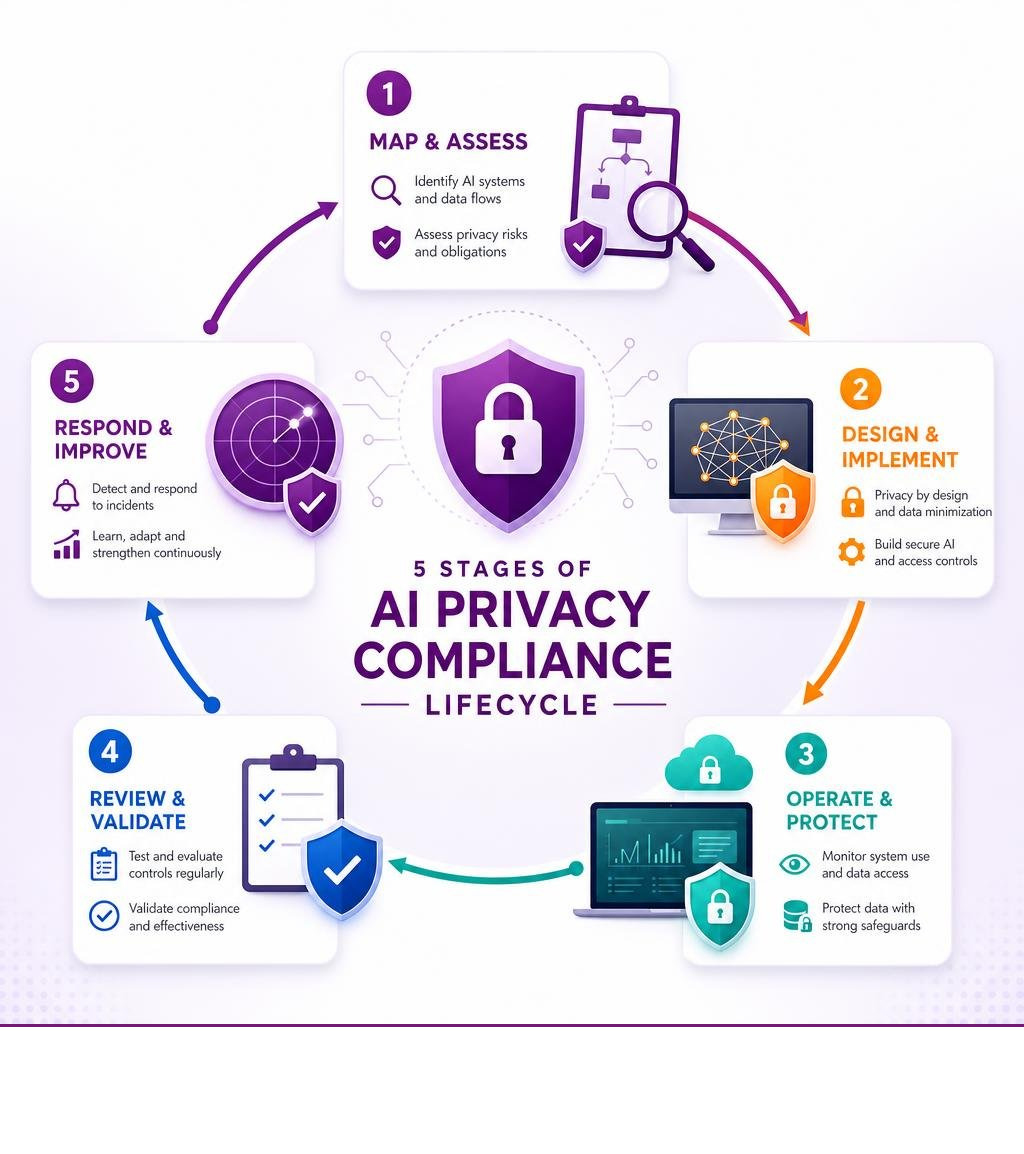
Step-by-Step Guide to Implementing Secure AI Privacy Compliance
Achieving compliance isn’t a one-time event; it’s a structural change. For our manufacturing and construction clients in Brookshire and Fulshear, we recommend following a framework that aligns with the NIST AI Risk Management Framework. This framework helps organizations manage the risks of AI while fostering innovation.
Here is our 4-step “Get It Right” process:
- Govern: Establish a culture of risk management. Who is responsible for AI oversight in your company? We help businesses set up accountability structures so that AI isn’t just a “tech thing,” but a leadership priority.
- Map: Identify where AI is being used. Are your CPAs in Missouri City using AI for tax analysis? Is your construction firm in The Woodlands using it for project estimates? You can’t secure what you haven’t mapped.
- Measure: Use quantitative and qualitative tools to check for bias and privacy gaps. This includes regular “red teaming” where we test the AI to see if it leaks sensitive info.
- Manage: Prioritize the risks you’ve found. Not every risk needs a million-dollar solution, but every risk needs a documented response.
For those working as government contractors, we provide a specific guide to NIST compliance for subcontractors that bridges the gap between general IT security and AI requirements.
Embedding Privacy into the AI Lifecycle
Privacy cannot be an afterthought. It must be “baked in” from the design phase—a concept known as Privacy by Design. This means performing Data Protection Impact Assessments (DPIAs) before you deploy a new tool.
We recommend using the UK ICO’s “eight questions” framework as a guide. It asks critical questions like: “How will you provide meaningful human oversight?” and “How will you ensure data minimization?” By answering these early, you avoid the costly “rip and replace” scenarios that happen when a regulator decides your tool is non-compliant.
Data Governance and Secure AI Privacy Compliance Policies
A strong policy is your first line of defense. Your internal AI policy should explicitly cover:
- Input Data Restrictions: Clear rules on what PII (Personally Identifiable Information) can and cannot be entered into an LLM.
- Opt-out Rights: How customers can request their data not be used for training.
- Retention Periods: AI data shouldn’t live forever. Define when it gets purged.
- Unauthorized Training Prevention: Ensuring your enterprise agreements with vendors (like Microsoft or Google) explicitly state they won’t use your data for their own model training.
By unlocking business potential with enhanced privacy, you aren’t just checking a box; you’re building a brand that customers in Houston and Katy can trust.
Leveraging Privacy-Preserving AI Techniques and Technologies
How do you use AI without exposing the raw data? The answer lies in Privacy-Enhancing Technologies (PETs). These are the “secret weapons” of secure AI privacy compliance.
- Differential Privacy: This adds mathematical “noise” to a dataset. It’s like looking at a pointillist painting; from a distance, you see the pattern (the insight), but up close, you can’t see the individual dots (the people).
- Federated Learning: Instead of bringing all the data to one central server (a massive security risk), the AI model travels to the data. It learns on-site—say, at a hospital in the Texas Medical Center—and only sends the “lessons learned” back to the main model, never the patient data itself.
- Synthetic Data: We can create “fake” data that has the same statistical properties as your real data. You can train your AI on the synthetic version without ever touching a real customer’s file.
- Homomorphic Encryption: This allows AI to perform calculations on data while it is still encrypted. The system never actually “sees” the plain text.
For businesses that need high-level security, exploring searchable symmetric encryption research can provide ways to keep data encrypted even during complex searches. At Impress Computers, we also guide clients toward private AI platform solutions that keep the entire AI environment within their own control, rather than the public cloud.
Cloud Infrastructure and Secure AI Privacy Compliance
Most AI runs in the cloud (AWS, Google, Azure). To keep it secure, we implement:
- VPC Service Controls: These create a digital “fence” around your data, preventing it from being exfiltrated even if an account is compromised.
- Data Perimeters: Ensuring that only authorized identities can access specific datasets.
- Transparency Tools: We use features like AWS Model Cards for transparency to document exactly how a model was trained and what its limitations are. This is vital for showing regulators that you are being responsible.
Navigating the Global Regulatory Landscape: EU AI Act vs. US Standards
If you do business internationally—or even if you just want to be prepared for future Texas laws—you need to understand the “Brussels Effect.” The EU AI Act is the world’s first comprehensive AI law, and its influence is spreading fast.
The EU AI Act uses a “Pyramid of Risk”:
- Unacceptable Risk: Banned systems, like social scoring or real-time biometric identification in public (with very few exceptions).
- High Risk: Systems used in critical infrastructure, education, or hiring. These require strict secure AI privacy compliance audits.
- Limited Risk: Systems like chatbots. They must be transparent so users know they are talking to an AI.
- Minimal Risk: Most AI applications, like spam filters, fall here.
In the US, we don’t have a single federal AI law yet, but the 2023 Executive Order on AI and the Blueprint for an AI Bill of Rights set a clear tone. They emphasize data minimization and protecting citizens from algorithmic bias. For our clients in the financial sector, we look at how these rules mesh with existing mandates, such as compliance for community banks.
Achieving Transparency and Secure AI Privacy Compliance
Transparency is the antidote to the “black box” problem. We help Houston businesses achieve this through:
- Explainability: Can you explain why the AI rejected a loan application or a job candidate?
- Model Visualizations: Using tools to show which data points influenced a decision.
- Plain-Language Summaries: Giving your customers a clear, non-technical explanation of how their data is used.
- Provenance Audits: Using tools like Data Provenance Explorer audits to track where training data came from and ensure it was legally and ethically sourced.
The Generative AI Security Scoping Matrix and Supply Chain Audits
To simplify AI security, we use a “Scoping Matrix” that classifies AI use cases into five levels. This helps us tailor the security controls to the specific risk:
- Scope 1 (Consumer Apps): Employees using public tools like the free version of ChatGPT. Risk: High data leakage.
- Scope 2 (Enterprise Apps): Paid versions with enterprise-grade privacy (e.g., ChatGPT Enterprise). Risk: Moderate, requires vendor audit.
- Scope 3 (Pre-trained Models): Using an API to connect a model to your own data. Risk: Requires secure API management.
- Scope 4 (Fine-tuned Models): Taking a base model and training it on your specific company data. Risk: High, data becomes part of the model.
- Scope 5 (Self-trained Models): Building a model from scratch. Risk: Maximum, requires full supply chain oversight.
A critical and often overlooked part of the supply chain is data annotation. Most AI models are trained by humans who “label” data. If those annotators are in a different country and have access to un-redacted PII, you have a massive privacy breach on your hands. We ensure that Standard Contractual Clauses for data transfer are in place to protect your liability.
Competitive Advantages of Responsible AI
Why go through all this trouble? Because trust is a currency. When people are increasingly wary of how their data is used, being the “safe” option is a massive competitive advantage.
For private AI for construction businesses in Katy or Sugar Land, secure AI means being able to analyze blueprints and project costs without worrying that a competitor might “hallucinate” your secret sauce through a public AI tool. It allows you to innovate with confidence, knowing your foundation is secure.
Frequently Asked Questions about Secure AI Privacy
How does the EU AI Act classify AI risk levels?
The EU AI Act uses a four-tier system: Unacceptable (banned), High-risk (strictly regulated), Limited-risk (transparency required), and Minimal-risk (no specific rules). Most business tools fall into the Limited or Minimal categories, but tools used for hiring or credit scoring are often “High-risk.”
What is the difference between differential privacy and federated learning?
Differential privacy is a data modification technique that adds mathematical noise to protect individual identities within a dataset. Federated learning is a decentralized training method where the model is trained across multiple devices or locations without the raw data ever leaving its original home.
How can I ensure my customer data isn’t used to train public AI models?
The best way is to use “Enterprise” versions of AI tools and have your IT provider (like us!) review the Terms of Service. Look for clauses that explicitly state “Customer Data is not used to train our models.” Additionally, implementing an “AI Gateway” can block sensitive data from being sent to unauthorized AI sites.
Conclusion
Navigating secure AI privacy compliance might feel like a daunting task, but you don’t have to do it alone. Whether you are a manufacturing plant in Rosenberg, a bank in Houston, or a CPA firm in Katy, the risks are real—but so are the opportunities.
At Impress Computers, we specialize in helping Houston-area businesses secure their digital future. With our 15-minute response guarantee and 99.9% uptime, we ensure that your AI journey is not only innovative but also fully compliant and safe from the ever-evolving threat landscape.
Ready to take the next step? Don’t leave your AI strategy to chance. Get started with the Hatz AI Training and Implementation Program today and let us help you build a secure, private, and powerful AI foundation for your business.
