
Why Secure Machine Learning Compliance Is Critical for Your Business Right Now
Secure machine learning compliance means building, deploying, and operating ML systems in ways that satisfy legal, security, and ethical requirements — before regulators, auditors, customers, or cyber insurers start asking hard questions.
Here is a quick breakdown of what it covers:
| Area | What It Means |
|---|---|
| Data Privacy | Protecting personal data used to train and run ML models |
| Algorithmic Transparency | Being able to explain how and why a model makes decisions |
| Bias & Fairness | Testing models to prevent discriminatory or harmful outputs |
| Governance | Assigning clear ownership and oversight for every AI system |
| Security | Defending models against attacks like data poisoning and model theft |
The pace of AI adoption is outrunning most organizations’ ability to govern it. Today, many organizations are using AI tools faster than their policies, vendor reviews, and security controls can keep up. That creates a real problem for U.S. businesses: sensitive data may be flowing into AI systems without clear approval, documentation, or monitoring.
That gap is about to become very expensive.
For U.S. businesses, the pressure is coming from federal agency guidance, sector-specific laws, state privacy rules, cyber insurance requirements, customer security questionnaires, and industry frameworks such as NIST. Healthcare, finance, legal, manufacturing, and government-contractor environments already face strict expectations around data protection, access control, auditability, vendor risk, and incident response. As AI becomes part of those workflows, machine learning systems need the same level of governance — plus new controls for model behavior, training data, explainability, drift, and adversarial attacks.
For businesses in industries like healthcare, manufacturing, finance, and legal services, the stakes are especially high. Machine learning systems in these sectors touch sensitive data, drive critical decisions, and face layers of overlapping regulation that traditional software compliance simply wasn’t built to handle.
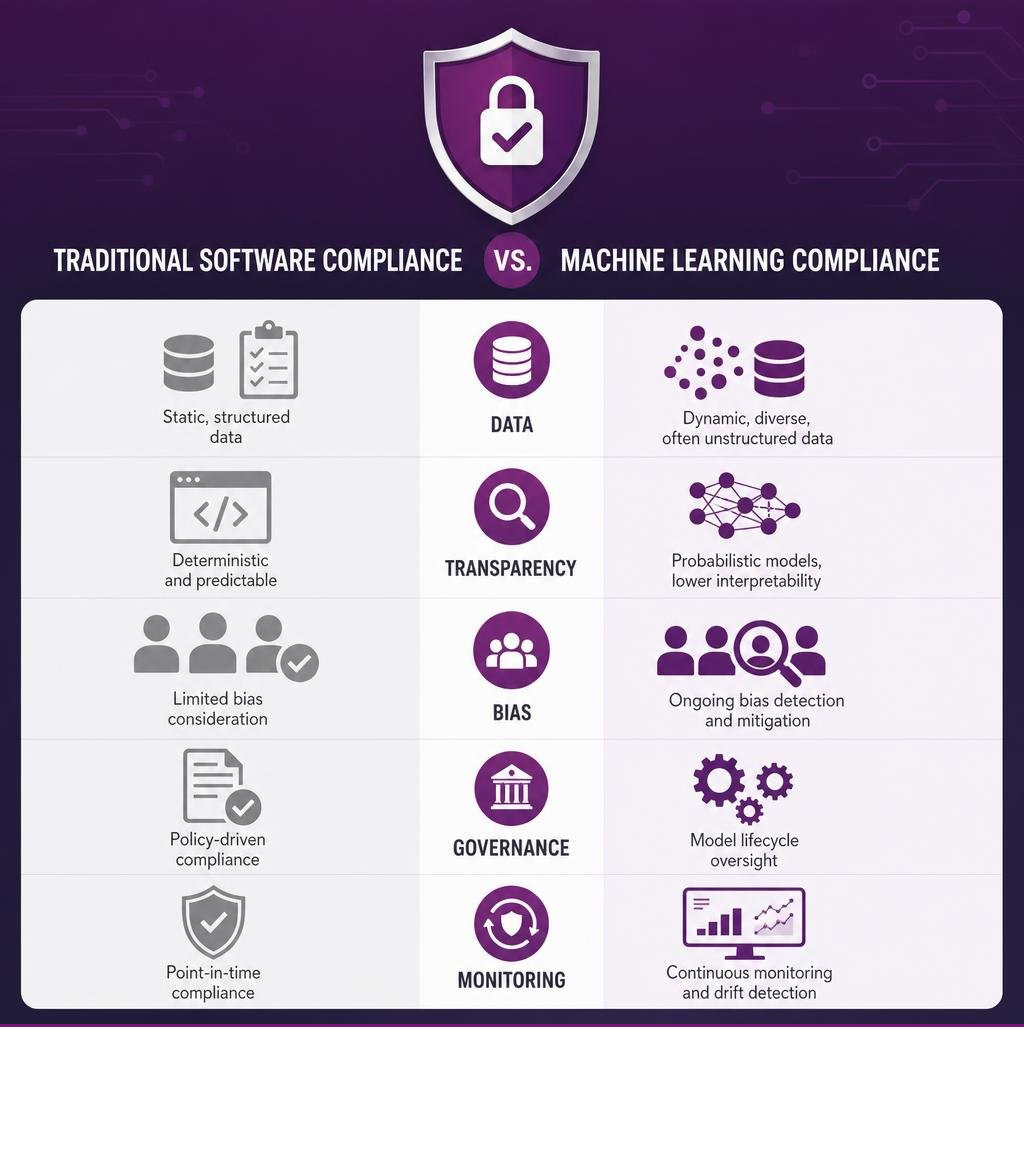
Traditional software compliance asks: “Does the system do what it’s supposed to?” ML compliance asks something harder: “Can you prove it’s fair, secure, explainable, and trustworthy — every time it runs?”
I’m Roland Parker, founder and CEO of Impress Computers, a managed IT and cybersecurity firm helping Houston-area businesses navigate exactly these kinds of compliance challenges — including secure machine learning compliance — for over 30 years. In this guide, I’ll walk you through the U.S.-focused frameworks, lifecycle controls, and practical steps your organization needs to stay compliant and competitive as AI adoption accelerates.
The U.S. Regulatory Shift: Why ML Compliance Matters in 2026
If you feel like the ground is shifting under your feet, you aren’t imagining it. U.S. businesses are moving from informal AI experimentation toward formal AI governance, security, privacy, and audit expectations.
The U.S. Compliance Reality: No Single AI Law, But Plenty of Obligations
The United States does not currently have one single nationwide AI compliance law that covers every business use case. Instead, companies face a layered compliance environment built from federal guidance, sector-specific rules, state privacy laws, customer contract requirements, cyber insurance expectations, and industry frameworks.
That means a Houston business using AI or machine learning may need to answer questions such as:
- What sensitive data is used to train, tune, or prompt the model?
- Who has access to the data, model outputs, and logs?
- Can the company explain decisions that affect customers, patients, employees, borrowers, or applicants?
- How are vendors reviewed before employees connect business data to AI tools?
- What happens if an AI system leaks data, produces a biased result, or is manipulated by an attacker?
Federal and State Expectations to Watch
In the United States, AI compliance is often tied to existing legal and security duties. Healthcare organizations must think about HIPAA. Financial institutions must think about GLBA, FCRA, FFIEC expectations, and model risk management. Federal contractors must pay attention to NIST-aligned cybersecurity requirements, CMMC, and customer-specific security clauses. Employers using AI-supported hiring tools may face state or local transparency and bias-audit rules.
For our local partners, stay ahead of these trends. For example, if you are a federal subcontractor, you should review our guide on NIST Compliance for Subcontractors to see how these standards are beginning to overlap with AI expectations.
Practical Trends for U.S. Businesses
- AI governance: Companies need written policies for approved AI tools, data use, review workflows, and accountability.
- Vendor risk: Businesses must understand where AI vendors store data, how they use prompts or uploaded files, and whether customer data is retained for model training.
- Security controls: AI systems need access control, monitoring, logging, endpoint protection, backup planning, and incident response coverage.
- Bias and explainability: AI used in lending, hiring, healthcare, insurance, or legal workflows needs stronger documentation and review.
- Cyber insurance and customer audits: Insurers and enterprise customers increasingly ask whether AI tools are governed, monitored, and secured.
The takeaway? Secure machine learning compliance is no longer a “nice-to-have” for early adopters; it is becoming part of responsible business operations for U.S. companies.
Core Elements of a Secure Machine Learning Compliance Framework
To move from “chaos” to “compliance,” we need to understand that ML systems require different controls than standard databases or web apps. In a traditional system, if the code is correct, the output is predictable. In ML, the “code” is learned from data, which introduces new vulnerabilities.
Traditional vs. ML-Specific Controls
| Control Type | Traditional Security | Secure ML Compliance |
|---|---|---|
| Data Protection | Encryption at rest/transit | Differential privacy & K-anonymity |
| Transparency | Open-source code reviews | Explainable AI (XAI) & Model Cards |
| Testing | Unit tests & Bug bounties | Bias detection & Adversarial red teaming |
| Governance | IT Change Management | Model Versioning & Data Lineage |
The NIST AI RMF: Your North Star
The NIST AI Risk Management Framework (AI RMF) is the gold standard for managing these risks. It’s a voluntary framework, but following it is the best way to demonstrate “due diligence” to regulators. It focuses on four core functions: Govern, Map, Measure, and Manage.
At Impress Computers, we often tell our clients in the Houston legal and banking sectors: compliance is about building a “culture of trustworthiness.” If you’re wondering where you stand today, ask yourself: How confident are you about your PCI and other compliance? If your standard IT compliance is shaky, your AI compliance will be too.
Emerging Standards: AI-SPM and ISO 42001
We are seeing the rise of AI Security Posture Management (AI-SPM). These tools provide visibility into your AI ecosystem, helping you find “shadow AI” (services your employees are using without telling IT). Additionally, ISO/IEC 42001 has emerged as the world’s first AI management system standard, providing a structured way to manage the risks and opportunities of AI.
Navigating the ML Lifecycle and Industry Standards
Compliance isn’t a checkbox you tick at the end of a project. It must be baked into the entire MLOps (Machine Learning Operations) lifecycle.
Implementing Secure Machine Learning Compliance Across the Lifecycle
We recommend a phased roadmap for our clients in Richmond, The Woodlands, and beyond:
- Phase 1: Assessment. Inventory every model and dataset. Who owns it? What data does it use? Create an AI Bill of Materials (AI-BOM).
- Phase 2: Foundation. Implement version control for both code and data. If a model starts making unexpected decisions, you need to be able to roll back to a previous version.
- Phase 3: Enhancement. Align controls with NIST guidance, internal security policies, and applicable industry requirements. This includes “secure by design” practices like input validation, access control, protecting model weights, and reviewing vendor AI tools before business data is uploaded.
- Phase 4: Optimization. Set up continuous monitoring for “model drift” (where the model becomes less accurate over time) and schedule quarterly audits.
One common pitfall we see is a lack of clear ownership. Does the Data Science team own compliance? Or the Legal team? The answer is both. You need a cross-functional team where the tech experts explain the “black box” and the legal experts map it to the law.
For those in the financial sector, your ML pipelines often fall under existing rules. Check out our resources on PCI Compliance and How Impress Computers Can Help You Stay Secure to see how standard data security overlaps with ML requirements.
Industry-Specific Requirements for Secure Machine Learning Compliance
Different industries face very different hurdles:
- Healthcare: AI used in clinical, administrative, or patient-data workflows must be evaluated against HIPAA privacy and security obligations, vendor agreements, access controls, audit logging, and incident response requirements. AI used for diagnosis or clinical decision support may also trigger FDA-related review depending on the use case.
- Finance: If you use ML for credit scoring, fraud detection, underwriting, or account decisions, you must consider the Fair Credit Reporting Act (FCRA), GLBA safeguards, model risk management, adverse action notices, and explainability expectations. This is where Explainable AI (XAI) becomes a practical compliance requirement, not just a technical feature.
- Banking: Small community banks in Texas have unique challenges. We’ve detailed these in our guide on What compliance regulations apply to small community banks in Texas?
- Human Resources: Employers using AI-supported screening, assessments, or hiring workflows should document how tools are selected, tested, monitored, and reviewed for bias, privacy, and explainability concerns.
Threat Modeling and Vulnerability Management in ML Systems
Standard cybersecurity protects the “house.” Secure machine learning compliance protects the “brain” inside the house. ML models are susceptible to “Adversarial Machine Learning” (AML)—attacks specifically designed to fool algorithms.
Unique ML Threats
- Evasion Attacks: An attacker slightly modifies an input (like adding invisible stickers to a stop sign) to make the model misclassify it.
- Data Poisoning: An attacker injects “bad” data into your training set so the model learns the wrong patterns.
- Model Inversion: An attacker queries the model repeatedly to “reverse engineer” the private training data.
- Prompt Injection: For LLMs, this involves tricking the model into ignoring its safety instructions.
Securing the Pipeline: The CIA Triad for ML
We apply the classic CIA Triad (Confidentiality, Integrity, Availability) to machine learning in a specific way:
Practical Security Steps
How do we stop these attacks? We use a “defense in depth” strategy:
- VPC Isolation: Use virtual private clouds to ensure your ML training environments have no direct internet access.
- Encryption: Use tools like AWS Key Management Service (KMS) to encrypt data at rest and in transit.
- IAM Roles: Apply the “principle of least privilege.” A data scientist doesn’t need the same permissions as a systems administrator.
- Red Teaming: Regularly hire experts to try and “break” your models. This is the only way to find vulnerabilities before the bad guys do.
Frequently Asked Questions about Secure Machine Learning Compliance
What is the difference between AI ethics and AI compliance?
Think of ethics as your “moral compass” and compliance as the “law of the land.” Ethics involves doing what is right (e.g., ensuring an AI doesn’t use offensive language), while compliance involves meeting specific legal requirements (e.g., documenting your data sources for a GDPR audit). Ethics often goes beyond what the law requires, but compliance is what keeps you out of court.
How often should machine learning models be audited for compliance?
We recommend a “continuous monitoring” approach, but formal audits should happen:
- Quarterly: For high-risk models in finance or healthcare.
- Annually: For lower-risk internal tools.
- Trigger-based: Any time you retrain a model with new data or when a major new regulation (like the EU AI Act) reaches a new milestone.
Who is responsible for AI compliance within an organization?
It is a team sport.
- Legal/Privacy Officers define the rules.
- Data Scientists implement the technical controls (like XAI).
- Security Teams defend the infrastructure.
- Product Owners are ultimately accountable for the system’s impact. At Impress Computers, we act as the “glue” that helps these teams work together by providing the secure infrastructure and monitoring tools they need.
Conclusion: Turning Compliance into Competitive Advantage
The road to secure machine learning compliance can feel like a mountain, but you don’t have to climb it alone. While many see these requirements as a burden, we see them as an opportunity. Companies that build trustworthy, secure, and transparent AI systems will win the trust of their customers, satisfy audits more easily, and reduce the risk of costly security or privacy failures.
Whether you are a manufacturing firm in Brookshire or a CPA in Sugar Land, the time to secure your AI future is now. We’ve helped Houston businesses stay secure for three decades, and we are ready to help you navigate the AI revolution.
Ready to start your journey? Check out our Hatz AI Training Implementation Program to see how we can help you roll out AI safely and compliantly in just 90 days. Don’t let your innovation turn into chaos—let’s build something secure together.
