Why Secure AI Governance Consulting Is Now a Business Imperative
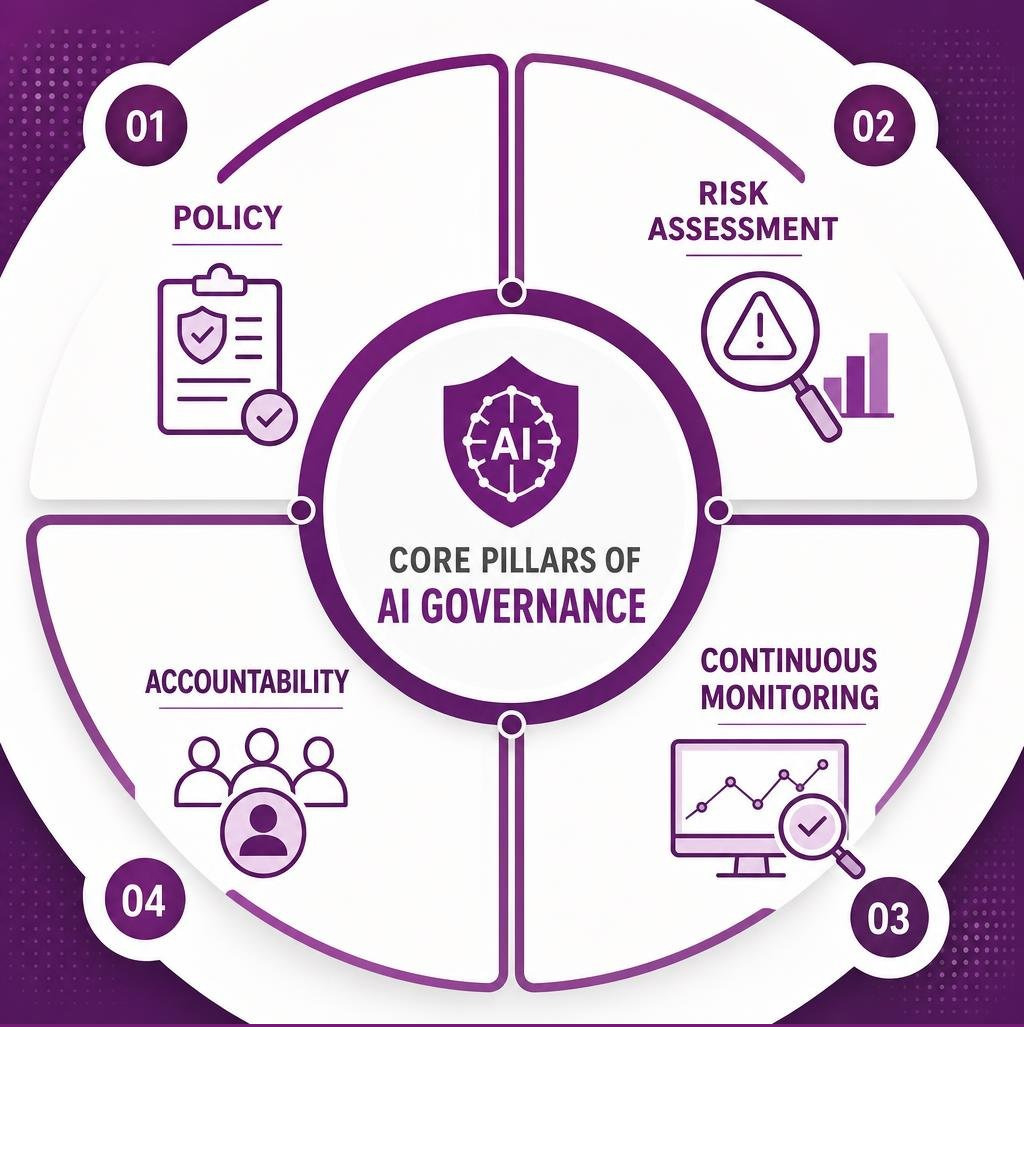
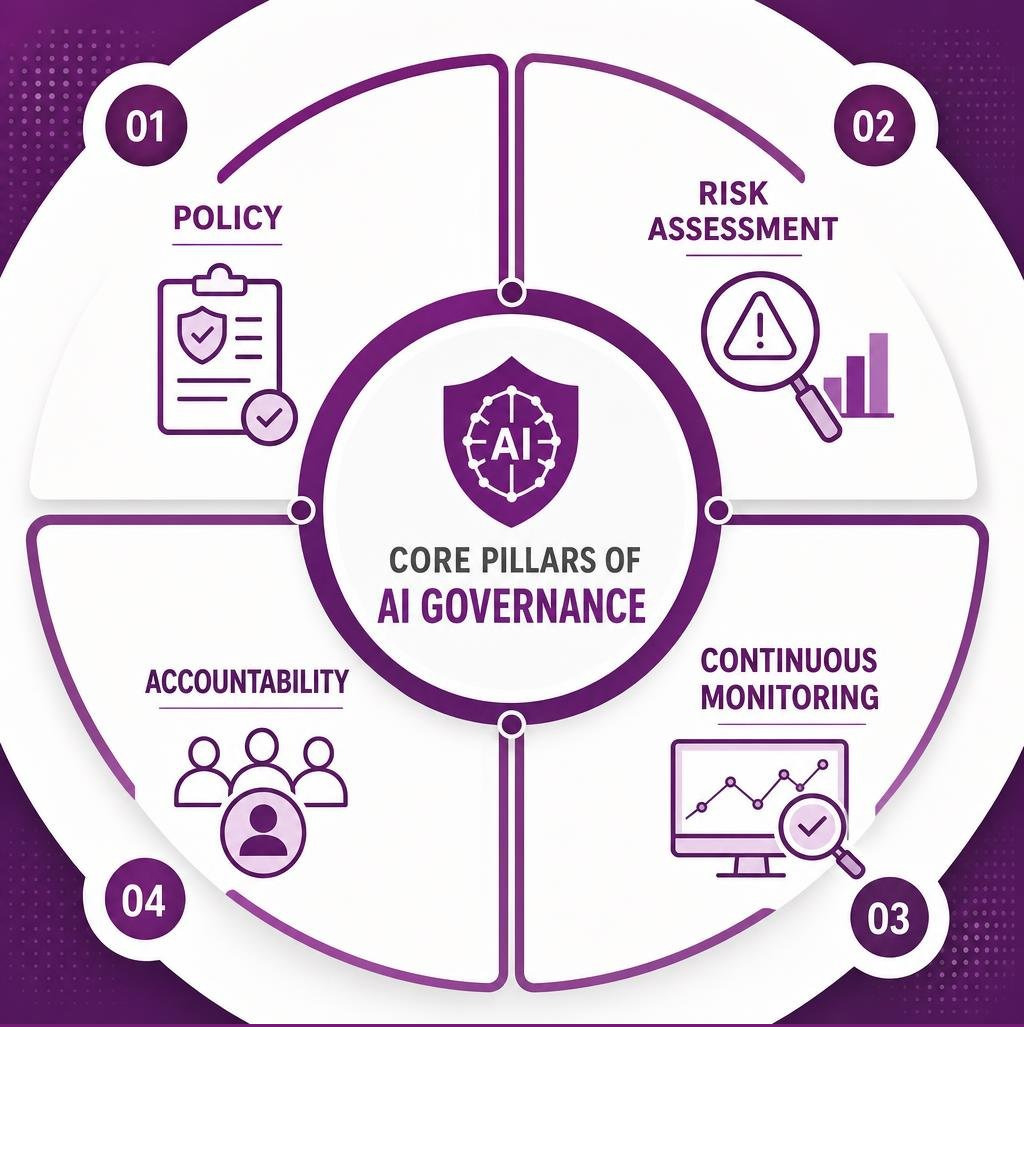
Secure AI governance consulting helps organizations deploy artificial intelligence responsibly — with the right controls, policies, and oversight in place to manage risk and meet regulatory requirements.
Here’s what it covers at a glance:
| Area | What It Addresses |
|---|---|
| Policy Development | Acceptable use, data handling, deployment approvals |
| Risk Assessment | Model bias, data leakage, adversarial attacks, shadow AI |
| Framework Alignment | NIST AI RMF, ISO 42001, sector-specific US compliance programs |
| Regulatory Compliance | HIPAA, SOC 2, FedRAMP, FTC enforcement expectations, state privacy laws |
| Continuous Monitoring | Model drift, audit trails, incident response |
AI has moved from experimentation into daily business operations — fast. Most organizations are now running AI tools across departments before any formal governance policies exist. That gap creates real exposure: data leakage, regulatory scrutiny, biased outputs, and loss of stakeholder trust.
The risks are not hypothetical. AI governance failures can cost organizations millions in regulatory penalties, model failures, and reputational damage. And with US regulators increasing scrutiny of automated decision-making, privacy, cybersecurity, and deceptive AI claims, the window to act is narrowing.
Governance isn’t just about checking boxes. A well-structured AI governance program enables faster, more confident AI deployment — because your teams know what’s allowed, what’s monitored, and what happens when something goes wrong.
I’m Roland Parker, Founder and CEO of Impress Computers and author of Mastering AI: How Business Leaders Can Harness the Power of Artificial Intelligence — and over my 30+ years helping Houston-area businesses navigate complex technology challenges, I’ve seen secure AI governance consulting become one of the most urgent priorities for manufacturing, construction, banking, legal, and accounting firms alike. The sections below walk you through exactly what AI governance is, what risks it addresses, and how to implement it effectively.
Simple guide to secure ai governance consulting:
What is AI Governance and Why is it Essential?
AI governance refers to the structured set of policies, technical controls, and operational workflows that guide how an organization designs, deploys, and manages artificial intelligence systems. It acts as the operational guardrails that ensure AI technologies remain safe, ethical, and legally compliant.
Without a formal governance program, companies essentially operate in a blind spot. While traditional IT governance handles general software and hardware assets, AI introduces dynamic, non-deterministic behaviors. Models learn, shift, and adapt over time, meaning their outputs can change even if the baseline code remains untouched.
Implementing a robust framework ensures that your organization can scale its technology investments with confidence. When properly executed, AI governance shifts from a defensive compliance checklist into a powerful business driver, unlocking sustainable innovation and protecting your brand’s reputation. To learn more about aligning your technology strategy with business outcomes, explore our guide on Mastering AI for Business Success.
The Role of Secure AI Governance Consulting in Risk Mitigation
For most mid-market enterprises and highly regulated businesses, navigating the complex intersection of data science, cybersecurity, and regulatory compliance is incredibly challenging. This is where specialized secure AI governance consulting becomes indispensable.
A technical consultant does not simply hand over a template policy document; instead, they conduct deep architectural and security reviews. They evaluate how data flows into your models, where sensitive information is stored, and who has access to model outputs. By partnering with experts, organizations can mitigate the most severe risks of AI adoption:
- Model Bias: Preventing algorithms from making discriminatory or unfair decisions in critical processes like hiring, lending, or healthcare.
- Data Leakage: Ensuring corporate IP and sensitive customer data do not leak into public LLMs or unauthorized training datasets.
- Regulatory Exposure: Aligning systems with localized and international legal mandates to avoid catastrophic fines.
Primary Risks Associated with Enterprise AI Adoption
Unregulated AI adoption poses massive operational and legal challenges. When employees use public generative AI tools to draft contracts, write code, or summarize financial reports, they may unknowingly upload proprietary source code or protected health information (PHI) to external servers. This lack of visibility, often referred to as “Shadow AI,” makes it nearly impossible for compliance officers to guarantee data privacy.
Furthermore, intellectual property (IP) and copyright disputes are rising. If an AI model is trained on copyrighted material without authorization, the outputs generated for your clients could expose your business to copyright infringement lawsuits. To understand how rapid adoption can outpace safety protocols, read about How Quick AI Development Puts Security and Privacy at Risk.
Technical Vulnerabilities and Adversarial Attacks
Beyond policy and compliance concerns, AI systems introduce an entirely new set of technical attack surfaces that traditional firewalls and endpoint security tools cannot protect.
Cybercriminals are actively targeting AI pipelines through sophisticated adversarial techniques:
- Prompt Injection: Tricking large language models (LLMs) into bypassing their safety guardrails to leak system prompts, access backend databases, or execute unauthorized commands.
- Model Poisoning: Manipulating the training data of a machine learning model to inject backdoors, causing the model to make predictable errors or exhibit malicious behavior under specific conditions.
- Model Theft: Reversing or extracting a proprietary model’s architecture and weights by querying its public APIs, effectively stealing valuable IP.
These technical flaws require rigorous engineering controls, secure software development lifecycle (SDLC) integration, and continuous runtime monitoring. For a deeper look at these specific attack vectors, check out our analysis of the Biggest Flaws in Generative AI and the Security Risks They Impose.
Comparing Leading AI Governance Frameworks
When establishing an AI governance program, organizations should not try to reinvent the wheel. Instead, they should align their policies with recognized US-focused standards and auditable management systems.
| Framework / Regulation | Primary Scope | Target Audience | Key Compliance Requirements |
|---|---|---|---|
| NIST AI RMF 1.0 | Non-regulatory, flexible framework focused on managing AI risks. | US organizations looking for structured risk management. | Categorizes activities into four core functions: Govern, Map, Measure, and Manage. |
| ISO/IEC 42001 | International standard for establishing an Artificial Intelligence Management System (AIMS). | Enterprises seeking formal, auditable certification of maturity. | Requires documented risk assessments, ethical policy development, and lifecycle controls. |
| US sector and state requirements | Compliance obligations tied to privacy, cybersecurity, consumer protection, healthcare, finance, government contracting, and automated decision-making. | US businesses deploying AI in regulated or sensitive workflows. | Requires appropriate safeguards, documentation, access controls, vendor oversight, audit readiness, and truthful AI-related claims. |
Selecting the right framework depends on your industry, customer requirements, and risk tolerance. Many organizations use the NIST AI RMF as their baseline risk management guide while building toward ISO 42001 certification to demonstrate maturity to clients and investors. For US organizations, AI governance should also account for sector-specific obligations, state privacy laws, FTC enforcement expectations, and contractual requirements from customers or government agencies. To learn how to select the right standards for your business, read our guide on The Best AI Security Compliance Services for Your Tech Stack.
Regulatory Compliance and US Standards
AI compliance does not exist in a vacuum. It must integrate with existing US industry-specific regulations that govern your business operations. For example, financial institutions should ensure AI systems support sound cybersecurity, vendor risk management, privacy, and audit controls across their technology environment.
Healthcare organizations deploying AI diagnostic tools, documentation assistants, or administrative workflows must maintain strict adherence to HIPAA guidelines to protect patient data. Businesses using AI in consumer-facing decisions, advertising, or customer communications should also ensure their claims and automated processes are accurate, documented, and defensible under US consumer protection expectations.
Furthermore, service providers handling enterprise data must ensure their AI integrations do not compromise their SOC 2 trust services criteria, while government contractors must align with FedRAMP standards.
Why Enterprises Partner with Secure AI Governance Consulting Experts

Building an internal AI governance team from scratch is incredibly expensive and operationally complex. Most businesses lack the specialized dual-expertise required: compliance teams understand regulations but lack deep technical knowledge of neural networks, while data scientists understand model architecture but often lack a strong grasp of cybersecurity and regulatory compliance.
Partnering with professional consultants bridges this gap. Experienced advisors bring a wealth of practical knowledge, proven methodologies, and pre-built policy templates to accelerate your implementation. This outside expertise ensures your governance program is both legally defensible and operationally practical, allowing your developers to innovate without being bogged down by bureaucratic friction. For more information on securing your deployment pipelines, explore The Best Services for Secure Machine Learning Deployment and Auditing.
Integrating AI Governance with Existing GRC Programs
An effective AI governance initiative should never exist as a siloed program. Instead, it must be woven directly into your existing Governance, Risk, and Compliance (GRC) workflows, cybersecurity protocols, and enterprise data management structures.
By utilizing your established GRC tools, ticketing systems, and risk registers, you can manage AI-specific risks alongside traditional business risks. This integration provides leadership with a single, unified pane of glass for risk visibility, streamlined reporting, and highly efficient audit preparation, reducing overall operational friction. To ensure your broader IT strategy is aligned, review these 6 Questions Smart Companies Ask Their IT Provider Every Quarter.
Selecting the Right Secure AI Governance Consulting Partner
When evaluating a consulting partner, look for teams that demonstrate deep technical security engineering capabilities rather than just high-level policy writing. Your partner must be able to conduct rigorous vendor due diligence, evaluate third-party software supply chains, and review model architectures for concrete technical vulnerabilities.
They should have a proven track record of working with regulated industries and a deep understanding of managed IT operations, ensuring that the security controls they design can actually be implemented and maintained by your IT staff.
Step-by-Step Implementation of an AI Governance Framework
Implementing a comprehensive AI governance program requires a structured, phased approach to ensure long-term success and minimal operational disruption.
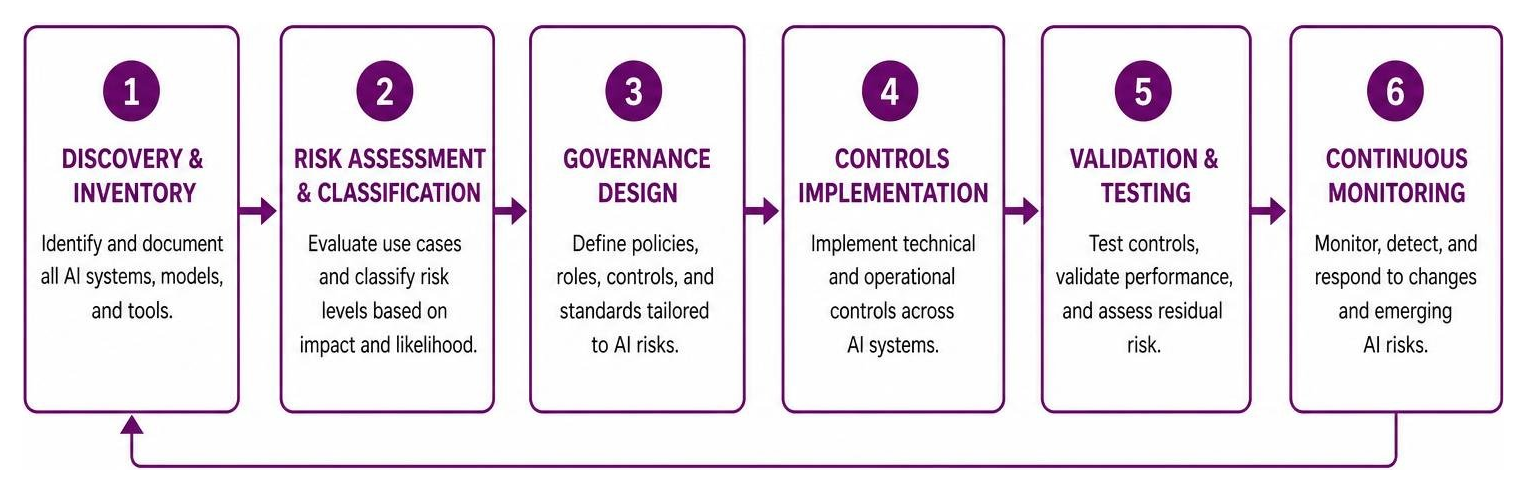
Phase 1: Discovery & Inventory
The first step is to locate and document every AI system, model, and third-party SaaS tool with embedded AI features currently in use across your organization. This includes identifying “Shadow AI” tools that employees may have adopted without IT approval.
Phase 2: Risk Assessment & Classification
Once your AI footprint is mapped, classify each use case based on its risk level (e.g., low, medium, high). Assess the data inputs, model logic, and potential business impact of a failure or data breach.
Phase 3: Policy Development & Guardrails
Develop clear, human-readable acceptable use policies, data handling guidelines, and model procurement standards. Establish ethical guardrails and define clear roles and responsibilities (RACI matrix) for system oversight.
Phase 4: Implementation & Control Deployment
Deploy technical controls to enforce your policies. This includes implementing data loss prevention (DLP) rules, configuring secure APIs, setting up identity and access management (IAM) boundaries, and deploying content safety filters. For businesses looking to secure their data within a dedicated, controlled environment, utilizing private cloud solutions is highly effective. Learn more about our regional services:
- Private AI Platform Services Richmond Texas
- Private AI Platform Services Cypress Texas
- Private AI Platform Services Rosenberg Texas
Phase 5: Continuous Monitoring & Audit
Establish automated pipelines to monitor models in production for performance drift, bias, and security anomalies. Maintain immutable audit trails of all major AI-driven decisions to ensure regulatory compliance and simplified reporting. For a detailed comparison of open-source risks versus private deployments, read our analysis on Private AI vs Open Source AI Why Security Conscious Businesses in West Houston Choose Hatz Private AI from Impress IT Solutions.
Frequently Asked Questions about AI Governance
What is the difference between AI governance and traditional IT governance?
Traditional IT governance focuses on managing static software, hardware assets, and network infrastructure. AI governance, however, addresses the dynamic, non-deterministic nature of machine learning models. Because AI systems learn, adapt, and can generate unexpected outputs over time, they require specialized oversight for model drift, algorithmic bias, training data integrity, and unique technical vulnerabilities like prompt injection.
How do US laws and regulations affect AI governance?
US AI governance is shaped by a mix of federal sector rules, state privacy and automated decision-making requirements, cybersecurity expectations, consumer protection enforcement, and contract obligations. A US-based business should evaluate whether its AI systems touch protected health information, financial data, government workloads, customer privacy rights, employment decisions, or regulated records. The right governance program documents those use cases, assigns risk levels, controls access to sensitive data, and keeps audit evidence ready.
Can AI governance be automated?
Yes, parts of the governance lifecycle can and should be automated. Organizations can use automated tools for continuous monitoring of model performance, detecting data drift, scanning for bias, and logging immutable audit trails. However, human-in-the-loop oversight remains essential for high-stakes decision-making, ethical evaluations, policy approvals, and incident response.
Conclusion
Navigating the complexities of AI adoption requires a careful balance between rapid innovation and rigorous risk management. By implementing a structured AI governance framework, your business can confidently leverage the power of artificial intelligence while ensuring full compliance with emerging regulations, protecting sensitive data, and maintaining stakeholder trust.
At Impress Computers, we specialize in helping Houston-area businesses in the manufacturing, construction, banking, legal, and CPA sectors deploy technology securely and efficiently. We back our managed IT and compliance services with a 15-minute response guarantee, 99.9% uptime, and deep industry-specific expertise. Whether you are located in Houston, Katy, Cypress, Sugar Land, Richmond, Rosenberg, Fulshear, Brookshire, Missouri City, or The Woodlands, our team is ready to help you secure your AI infrastructure.
Ready to take control of your AI strategy and build a compliant, secure future? Discover how our Hatz AI Training Implementation Program 3 Month Rollout can guide your organization from initial readiness to continuous, secure oversight.
